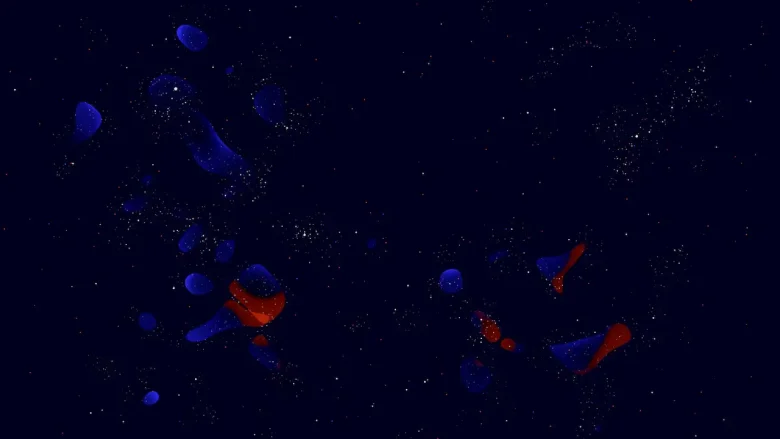
The product of a sole indie developer Steph Thirion, the designer of mobile classic Eliss, Faraway is a 2D arcade puzzler that relies on quick thinking and even quicker reactions as you fly around a procedurally generated universe.
As a soaring, ice-blue comet, the gameplay sounds simple. Slingshot your way between designated areas of stars, highlighted by a coloured marker onscreen until you reach a large red circle. Once inside, the timer stops and you’ll connect the individual stars within using a golden thread, creating constellations as you swing from orbit to orbit of each pinprick of light. The larger and more complex the constellation, the more points you’ll receive and you’ll have extra time added to your ever-diminishing countdown clock. Create ever more complex designs with loops and more stars and you’ll rack up an even higher score from combos. Simple.
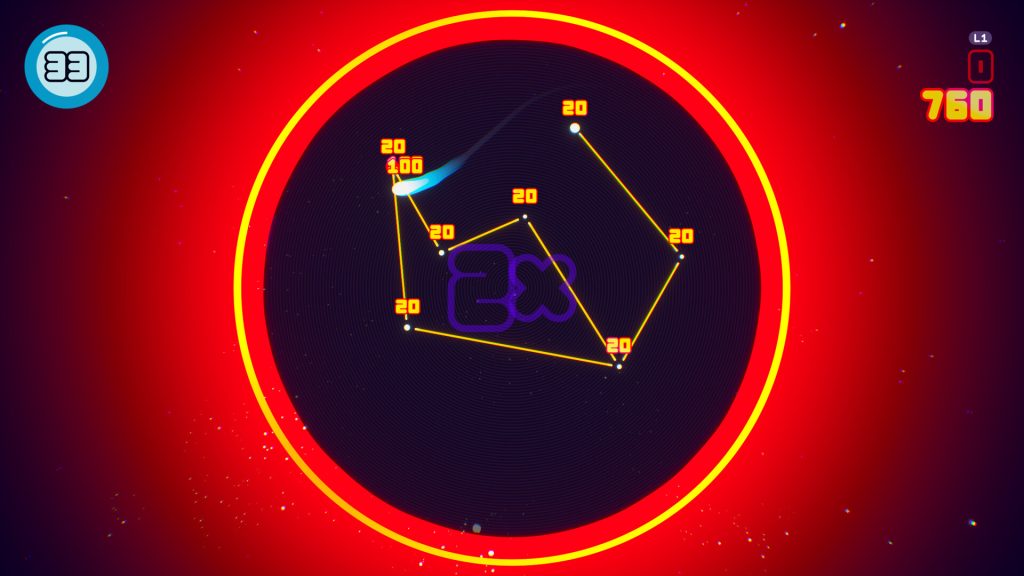
However, there’s a catch. The golden line cannot cross or touch itself at any point or your run in that area is completed, the points totalled and you’ll find yourself out in open space once again, racing against the clock to find another constellation to connect. With the self-propelled comet, possibly a shooting star, adhering to the law of gravity, Faraway will have you use celestial bodies to propel yourself in the right direction, slingshotting from one to another using their gravitational fields. Orbits are handily previewed as you fly past, red areas highlighting the optimum release zone for maximum velocity as you careen across the cosmos.
If all of this sounds a bit too much to process on paper, it becomes a lot easier to understand when seen in action. You only ever require a single button to enter an orbit and you let go to release yourself. It’s straightforward and relatively intuitive. The challenge comes from the race against time to make it to the next puzzle area, testing your rhythm and awareness, and your ability to react quickly whilst still planning a few moves ahead, figuring out the optimum path to squeeze as many points as you can from each challenge.
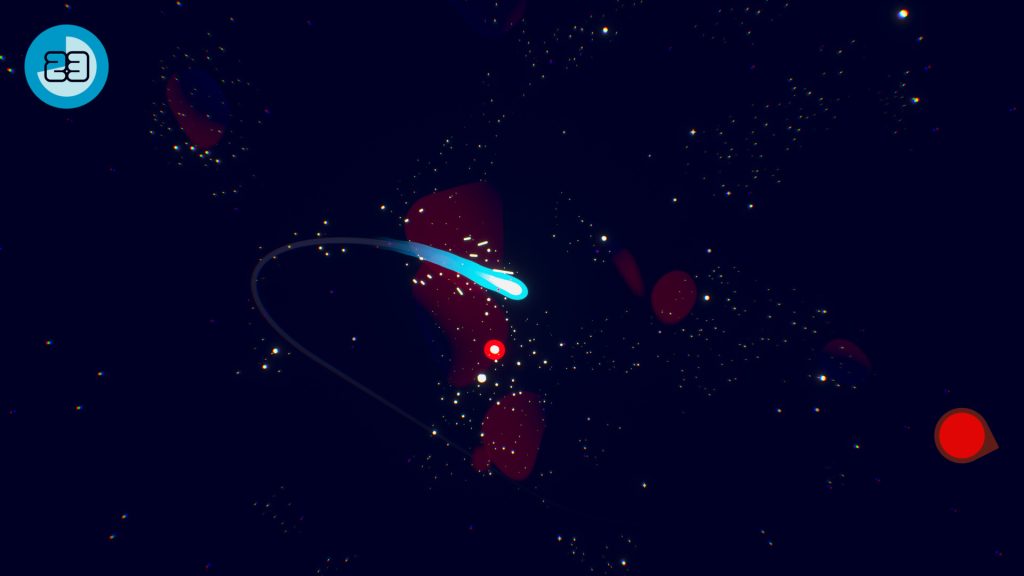
There’s certainly a learning curve, as even after a few hours with Faraway, I was still getting my brain around how best to navigate each star formation. You’ll curse as you realise you’ve cut off your own planned route. You’ll run out of precious time just a few pixels outside of the nearest asterism and finish the run. You’ll slow down and quietly succumb to universal entropy. Then you’ll come back for more.
As you become more proficient, the gameplay will respond with increasing complex puzzles and faster speeds, testing you even more, the deeper you go. On top of this, there’s a series of sixteen handcrafted puzzles, separately accessible from the main menu to test your mettle against, putting your skills acquired from the main mode to good use. They’re a test of your optimisation skills, each with three ranks for scoring and offer a change of pace from the endless main mode.
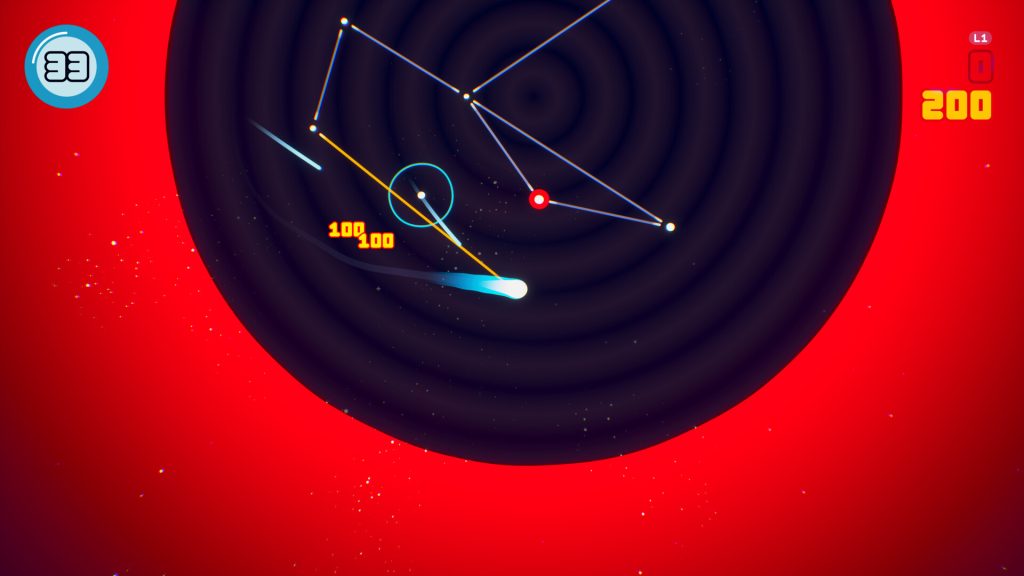
Faraway, whilst certainly requiring some speedy reflexes and a bit of brainpower, is still a relaxing play. Rhythmic synthesiser arpeggios serve as a chilled backdrop to your intergalactic travels. A crisp, clear, minimal art style allows for fast paced decision making whilst still retaining a recognisable character. Restarts are fast and there’s very little friction between runs for an ease of play that makes losing an hour to Faraway all too easy. However, Faraway certainly won’t be for everyone and I can see how some players will struggle to get to grips with the mechanics of the scoring and combo system.
There’s hidden depth to the simple controls that reward perseverance and solid practice and Faraway features the classic “easy to play but difficult to master” gameplay that is the hallmark of a great arcade game. It’s the satisfaction of creating your own constellations and the soothing atmosphere that will keep players coming back for just one more try.