
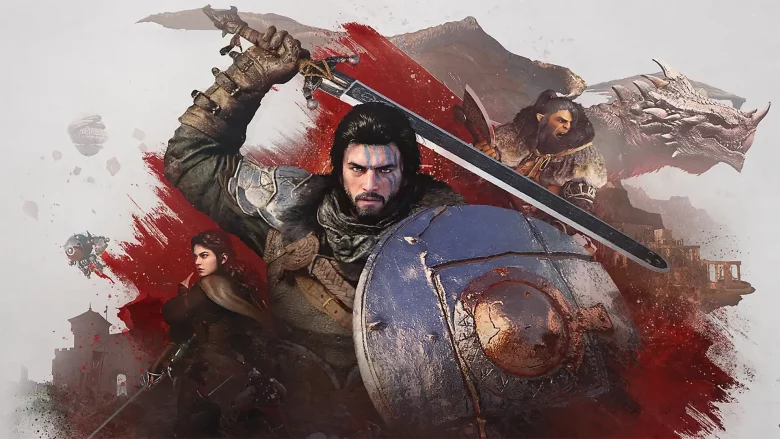
You are not prepared for Crimson Desert. You might think you are; you might have watched every trailer and deep-dive Pearl Abyss has put out. You might have watched or read every preview released in the lead up to today. You’ve probably played every open world adventure ever made. But I’m telling you now: you are not prepared for Crimson Desert.
Before I begin describing my time in Pywel, I’m going to drop some titles in here: Breath of the Wild, Dragon’s Dogma, Red Dead Redemption 2, The Witcher 3, Monster Hunter Wilds, Elden Ring, GTA 5, Black Desert Online. These are the main games whose DNA can be found in huge, bleeding chunks throughout Crimson Desert. It’s not that it’s derivative, per se, either, it’s more that it’s so staggeringly, almost greedily ambitious and all-encompassing that there are very few mechanics Pearl Abyss hasn’t found some use for in this bewilderingly vast open world.
Arguably, there’s just too much in it, and the abundance of systems and mechanics, which it’s still unlocking and tutorialising well beyond its 70th hour, layer atop one another like some horrifying man-eating trifle that any dessert bowl would struggle to contain. But at the same time, this is part of its almost never-ending appeal. It’s the friend who is constantly borrowing money and getting you into trouble but who’s bottomless charisma constantly charms your wallet open. It’s beautiful, too, sometimes distractingly so, and deeply, vibrantly alive. But by all the beards in Skyrim, is it bloody big.
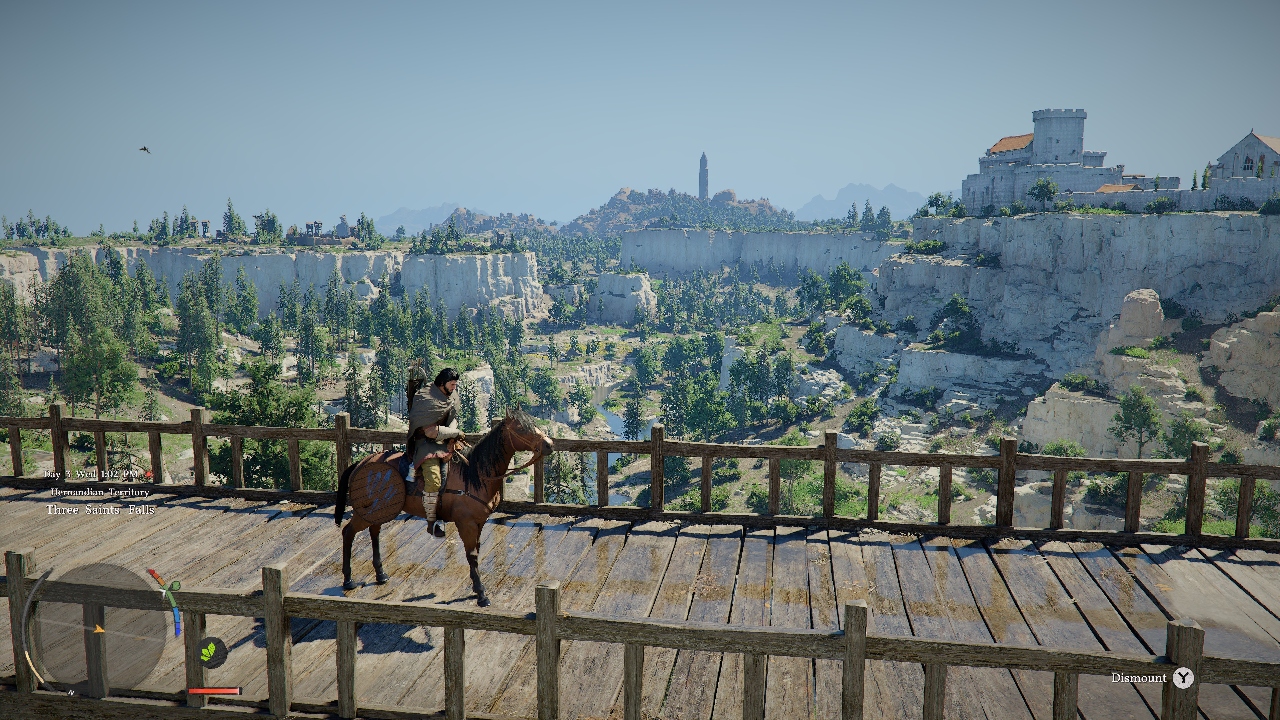
I haven’t seen it all. In fact it would take potentially hundreds of hours to see it all, but that’s more down to how the game is set up and structured than anything else. For example, there are essentially two main storylines to follow. I’ll try to avoid spoilers here but it’s hard to not mention some of the stranger elements. On the one hand you play as Kliff, with help later from two other playable characters that you’ll need to unlock, and are restricted in what they can and cannot do, and when you can use them.
Kliff is a Greymane, part of a mercenary company reminiscent of the Band of the Hawk in Berserk. In the opening, the Greymanes are ambushed by their rivals, the Black Bears, the leader is killed, the group is scattered, and Kliff is left for dead with a bitching new scar on his throat. One primary storyline follows Kliff’s attempts to rebuild the Greymanes, establishing a new camp and seeking out the disparate remnants. This is by far my favourite element of the open world, alongside a series of quests for the mysterious, childlike Shai that feel whimsical and fairytale-like.
Building up the camp requires a full management mini game that sees you complete side quests for the people of Hernand and the surrounding provinces, while searching for your former allies and managing the camp’s provisions, funds, and activities. The Greymanes are a great bunch as well, little generic in their stock characterisations but with some genuine standouts like foul-mouthed troublemaker Yann, wind-up merchant archer Naira, and the hobbled Marius, who gives you most of your broader objectives. This side of the game takes up much of the first “half” of the overall narrative, eventually seeing you with a farm, your own stables, vendors, and, of course, a quest for revenge. As you move beyond the midway point of the story, Crimson Desert continues to introduce new mechanics, including larger scale battles that can be incredibly tough to overcome.
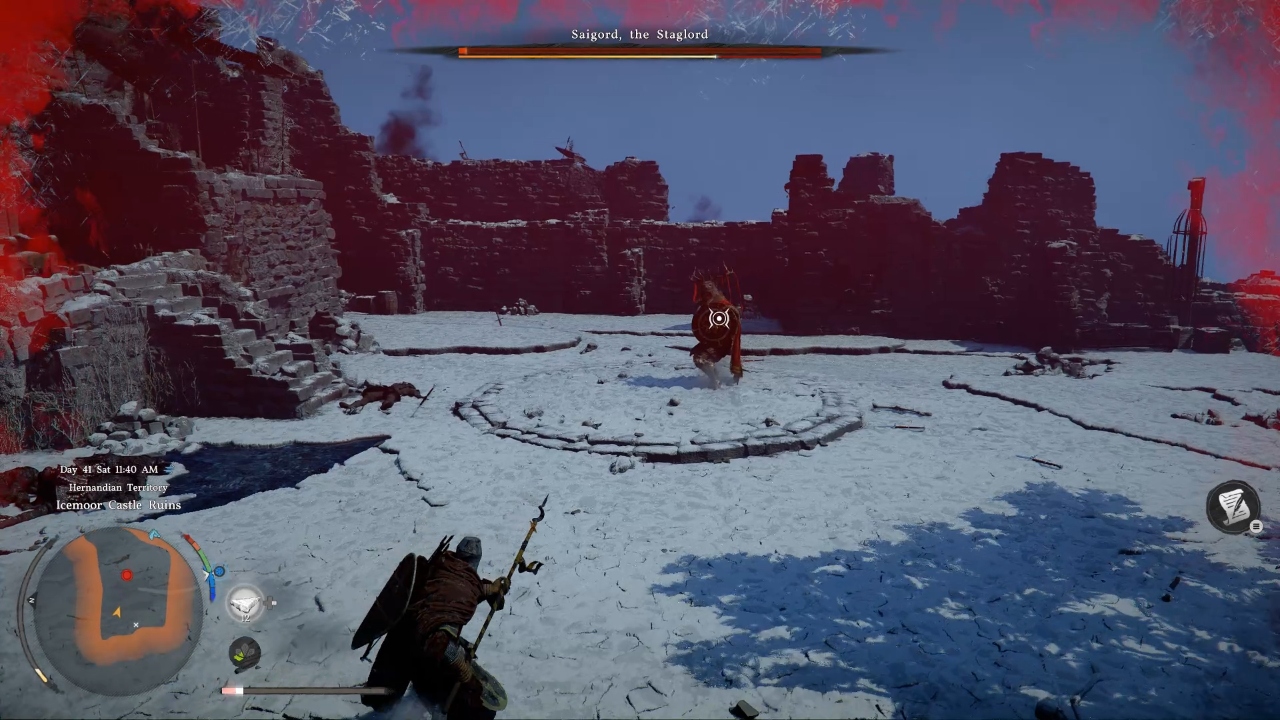
One of my favourite elements is Kliff himself. He’s almost Geralt-like, living his life by a strict code of conduct. Sure, he might put on a mask and rob the odd place, but he won’t tolerate bullies and, while a touch on the dull side, he comes across as infinitely reliable. On the other end of the narrative is Kliff’s slow discovery of a side of Pywel he never knew existed, remnants of an ancient advanced civilisation that may or may not be so “ancient” after all. Here you’ll make sojourns to the Abyss, ironically situated in the sky, spread across a series of floating islands from which you can actually skydive back to Pywel. Elements of this technology are scattered everywhere throughout the world in the form of environmental puzzles you’ll manipulate with the Axiom Bracelet, a piece of tech that allows you to move large objects, power devices, smash through special walls, and even traverse the environment. Add in a glider (here in the form of black wings) and it’s fairly easy to see the Breath of the Wild influences.
But this element is also the most disjointed, and at times feels almost bolted onto the side of the other critical path. It’s also the only way to properly advance the narrative, open up new areas, and acquire essential new skills. Crimson Desert then peppers the world with hundreds of side quests, commissions, fetch quests, activities, secret puzzles, hidden treasures, bandit camps, optional bosses, and tertiary storylines. And it does all of this with no Ubisoft-style checklist, and very minimal handholding or signposting. You get an objective marker and a single line instruction for most quest steps, and then work it out for yourself. And when I say some of it is obtuse, I’m not joking. In fact, I’d argue there are things that simply don’t follow any logical path.
For example, holding LB will raise Kliff’s lantern, highlighting power sources for Axiom tech, and revealing distant points of interest. Pressing RB will then “deflect” the light, causing those distant points of interest to glare so you can better pinpoint their location. Now pressing LB again will focus the light, allowing you to burn bracken that’s in your way. Often you must do this to progress, even though there’s likely a naked flame nearby, and whenever Kliff needs to light a bonfire, cook fire, or lantern in the game, he just does it with what I presume is a flint and tinder. See? Makes no sense.

This is indicative of one of Crimson Desert’s major, unavoidable issues: the open world is open, but that doesn’t mean you’re free. Now some of this may be patched on or after launch, but for instance there’s a crucial skill needed for much of the side content that the game wants to give you in Chapter 4. However, if you don’t follow the direct route to the objective, you will miss it completely, and there is no other way to get it until Chapter 9, which could be another forty hours away or more. The worst part? It’s the only way to unlock direct fast travel to the Greymanes camp and Kliff’s house. There are other examples. You can stumble on side content where you kill a group of enemies, who then won’t respawn when you get the official quest, and you can find objects out of order which then confuses the game logic so much it simply softlocks you out of progression. It’s juggling so many balls, some of them will inevitably drop.
The second core issue – and this may be on me although I know I was not the only one struggling – is boss difficulty. So combat in Crimson Desert is, for the most part, wonderful. You’ll repeatedly be up against ten to twenty foes, and you’re so ridiculously overpowered against fodder that combat is a cathartic joy. Kliff can use sword and shield, dual wield (if you can work out how as the game does not tell you), use two-handed weapons like spears and greatswords, and every fighting style is fluid, brutal, and satisfying. The other two characters have completely different styles altogether, though the way the game lets you level up means they’ll feel frustratingly underpowered for a lot of it.
However, bosses in this game can be an absolute nightmare. Most of the primary story bosses have three full health bars, and some of them are so aggressive that a common tactic was to load up on healing meat, itself a chore to acquire in vast numbers, and just tank as much as possible while learning their patterns. The kicker? There are no checkpoints between phases, and you must watch the over the top, bombastic cutscenes that play out before and during every time, as you can’t skip any cutscenes in the game, no matter how many times you’ve seen them.
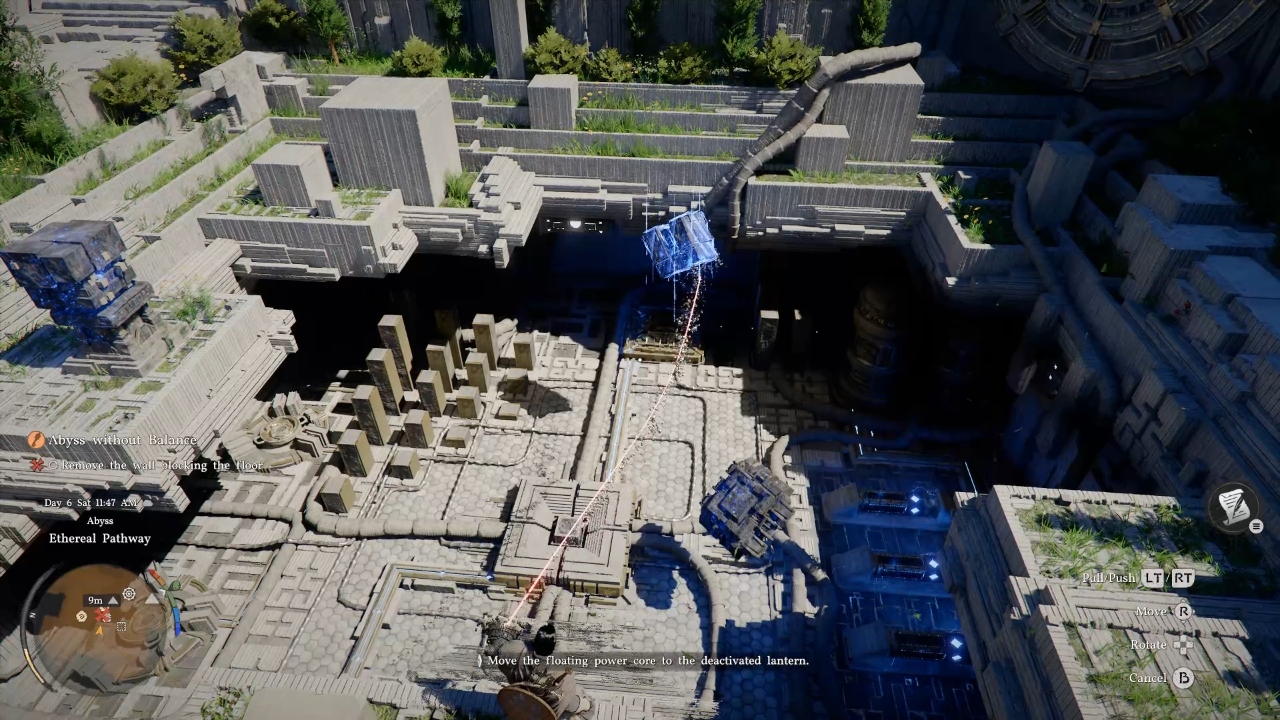
One boss fairly early in the campaign made me question whether or not I wanted to play any game ever again, it was so aggressive. Though what made it exponentially worse was the camera always being stuck up Kliff’s arse and the ragdoll physics that saw me literally bouncing off walls when it launched me. I won’t say it’s all bad design (although some bosses undoubtedly are guilty of that; remember the name “Tenebrum” and get back to me) but many are too fast, too hard-hitting, and too long. Not every one I’ve faced was like this, which admittedly is only a percentage of the promised seventy-six. Some of them don’t feel fair, is my biggest takeaway, and before you ready a snide “git gud”, I get it. I play Soulslikes for fun. I can handle bosses with learnable patterns and tight timing. This is not that; it’d more that a lot of the story bosses are clumsy, awkward, over-tuned progress walls that utterly derail the chill atmosphere and upwards momentum of the rest of the game.
It’s also fair to say that Crimson Desert has a bit of a villain problem in the main story. It can never seem to settle on a big bad. It introduces one fairly early on who’s then absent for most of the game, and it instead seems to cycle in operatic, posturing enemies each chapter who Kliff usually dispatches by the start of the next. Coupled with the mostly freeform structure, this gives it a bit of Villain of the Week vibe that sometimes works, and sometimes just adds to the feeling of disconnect.
The final issue I have is that puzzles are some of the most obtuse conundrums I’ve ever seen, to the point that I solved most of them by sheer luck or brute force. Crimson Desert explains very little, and a lot of what it does explain it does so badly. Perhaps this is a hangover of Pearl Abyss working on an MMO for so long and assuming there’ll be a ready made community of gamers to collaborate on this title, but like the boss fights, the puzzles are a regular progress killer and source of rage. Now I absolutely get that some people will be excited at the prospect of such challenges, and I salute those who are, but the more casual gamers out there bewitched by the stunning trailers and gorgeous world might be regularly put off, as I have been throughout all the hours I’ve spent in Pywell. Yet I can’t deny that Crimson Desert is a special game, and a singularly unique experience. The world itself has to be seen to be believed. That I can run the game on ultra settings with zero issues on a RTX 4070 is tantamount to witchcraft.
I can say without hyperbole that only Red Dead Redemption 2 has hit the heights that Crimson Desert hits in terms of the visual splendour of its play-space. It is truly, truly staggering to look at, with a real sense of flow to its environments as you travel from region to region. It has unmatched scale and scope, and there were times when the weather effects kicked in and I’d have to just stand in the rain and marvel at the change in atmosphere. It’s palpable, and genuinely a cut above any other open world I’ve played recently, maybe ever.
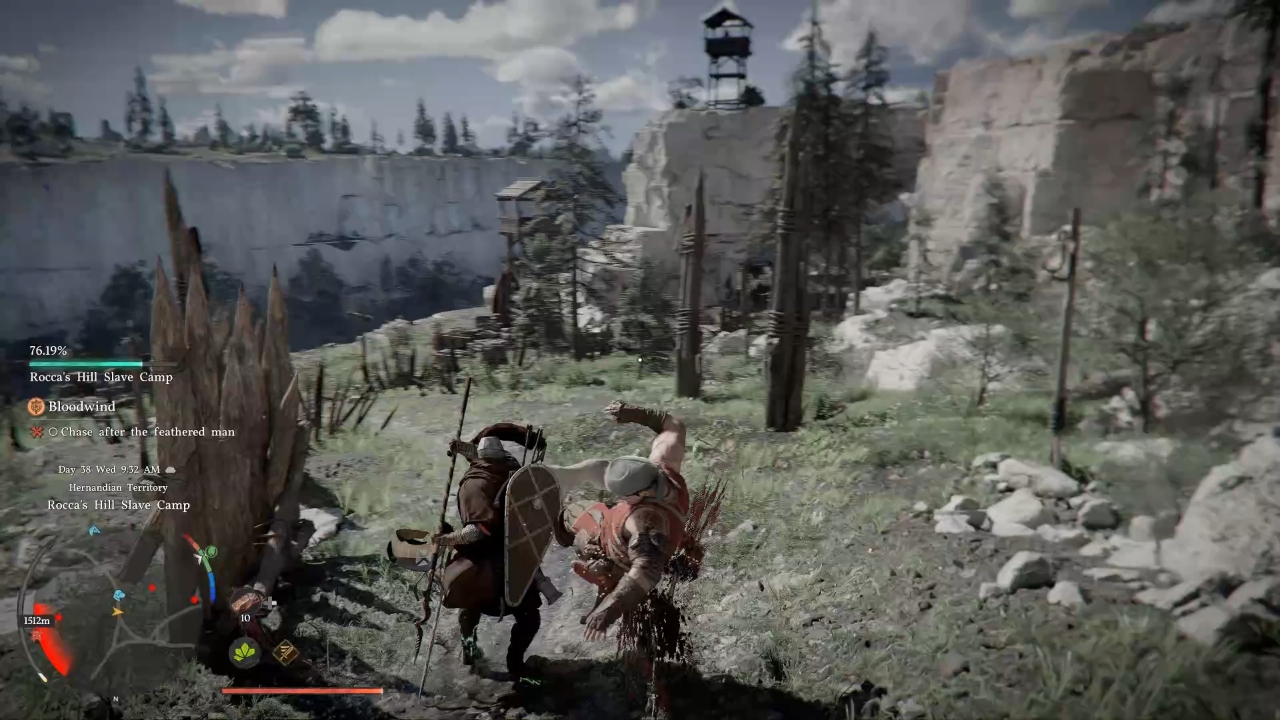
It also feels undeniably alive. The day / night cycle may be a mostly cosmetic illusion, but the way the world changes under night is incredibly effective. Wildlife is everywhere, and not just deer and foxes, but dozens of varieties of bird, insects, lizards, rodents, some fantastical, most real-world. And you can pick up, catch, or hunt all of them. Animals drop meat, skins, claws, and bones, while birds drop feathers and sometimes eggs. You can fish with a system lifted wholeheartedly from Monster Hunter Wilds, and these can all be cooked as well, to give health and, later, buffs. When you unlock cauldrons you can make revive pills, and potions, as well as dyes for your gear. A blacksmith will craft and refine your gear, while witches can insert and remove Abyss Cores from your equipment that give you buffs or special abilities like stunning nearby enemies on a successful parry.
The equipment system is malleable and free form, with weapon wheels letting you cycle left and right hand, or every armour slot even mid-battle. Little visual touches like displaying rings, earrings, and necklaces, and having some hoods you can pull up combine with tiny details like Kliff’s voice being muffled when in a helm to immerse you deeply in the game world. Of course this immersion, too, has its annoyances, and a lot of them stem from there simply being too much going on at any one time.
Fast travel is reliant on solved puzzles and teleporter pads, which you’ll need to find in the world. For the most part they are widespread and hard to find, so each one feels like an achievement. What doesn’t feel good is the unskippable animation every time you do it, and the fact you can’t just teleport straight into town or your camp, and must always walk a bit. You have multiple mounts of various species, as well as dogs and cats you can tame that will loot corpses for you, but you can’t name them and make them feel unique. The inventory system has been patched for launch, but while you have more slots, there is no stash to save or store gear so you have to just carry everything with you at all times, from armour and ammunition to alchemy ingredients and decorations for your house. Oh, and though there are bounties spread across the whole world, each region has only one jail, and you will need to carry each bounty, on your shoulder, the entire way back every time. It’s mind-boggling.
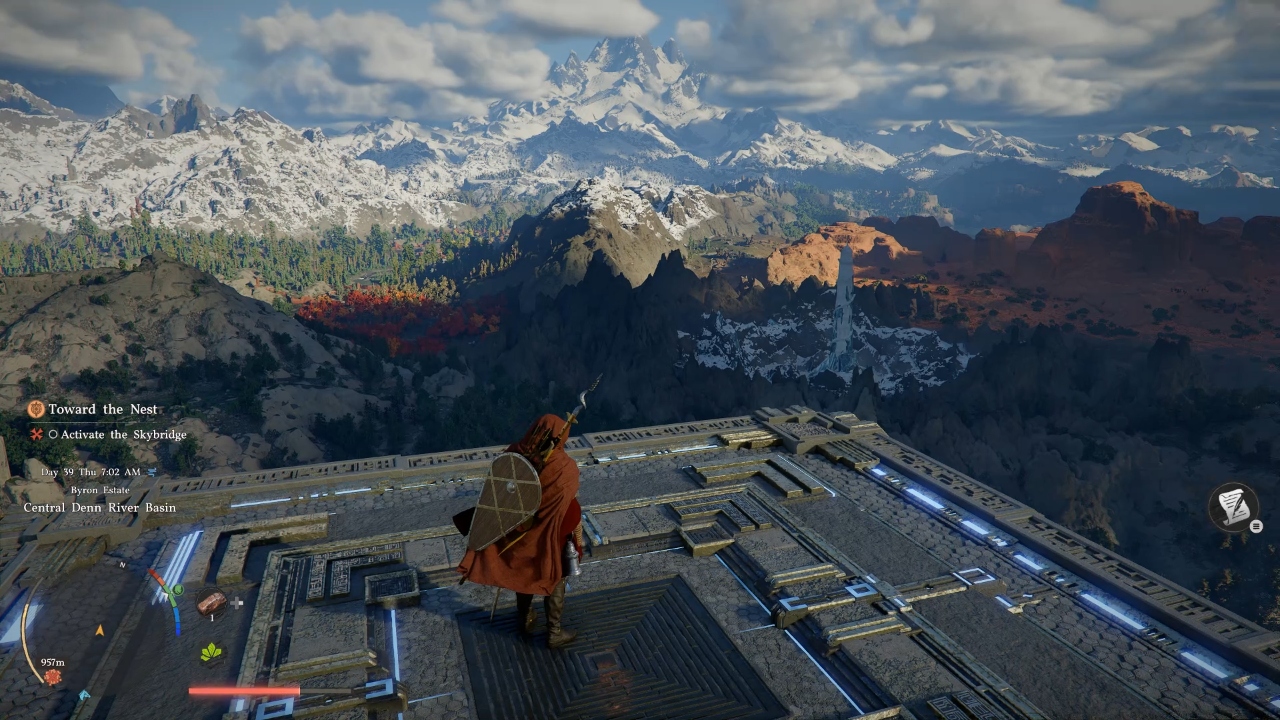
Which is why I say you are not prepared for this game, even if you think you are. I haven’t really touched on how the world changes with your actions, the wealth of minigames to be toyed with, the wilder technology you’ll uncover later, most of which has been shown in trailers already. There are dragons, too, but much, much later into the game. Those going in must ready themselves, though, for each boss to be a monumental challenge, to search out guides for what should be simple things because, oh yeah, some puzzles require such pinpoint precision that you’ll believe you’re doing it wrong and waste time on wild goose solutions only to realise you needed to just nudge something half an inch left (I did this several times). But also, you need to be prepared for the fact that Crimson Desert has the potential to ruin all future open world fantasy games for some time, so complete and filled it is with life and vibrancy. But it’s not quite that game yet; it needs a little tweaking to get there.
One thing that is abundantly clear is that Crimson Desert is special. It’s frustrating and buggy and can be very player-unfriendly, but it’s also beautiful, deep, seemingly endless and monumentally, perhaps detrimentally, ambitious. You’ve played dozens of games like it, yet it’s like nothing else you’ve ever played, and that’s the paradoxical statement I’m choosing to end on because it so perfectly encapsulates what this adventure is. For better or worse, people will be talking about Crimson Desert for years to come, and that’s an achievement in itself.