

Fishbowl is a hard game to review. It’s almost entirely driven by its narrative, which explores themes of grief and isolation set to a backdrop of 2020’s pandemic. For some, that may be a non-starter, as revisiting that particular point in history can be difficult. If you’re up for it though, Fishbowl offers a unique perspective on dealing with loss while the world around you falls apart.
Despite being set halfway across the world for me, in India, by setting the story at the start of the global pandemic it immediately provides a familiarity that brought back some of my own feelings from that time. You play as Alo, a video editor that recently got her dream job working on videos for her favourite streamer, who is branching out into TV and other avenues. Alone in a new city, she’s quickly put on the backfoot as she has to start working from home as the world around her slows to a crawl due to the pandemic. It made me think of my own experiences, being dragged out of an office surrounded by friends and the shock I felt moving to remote working, and helped me connect with Alo as she tries to navigate this.
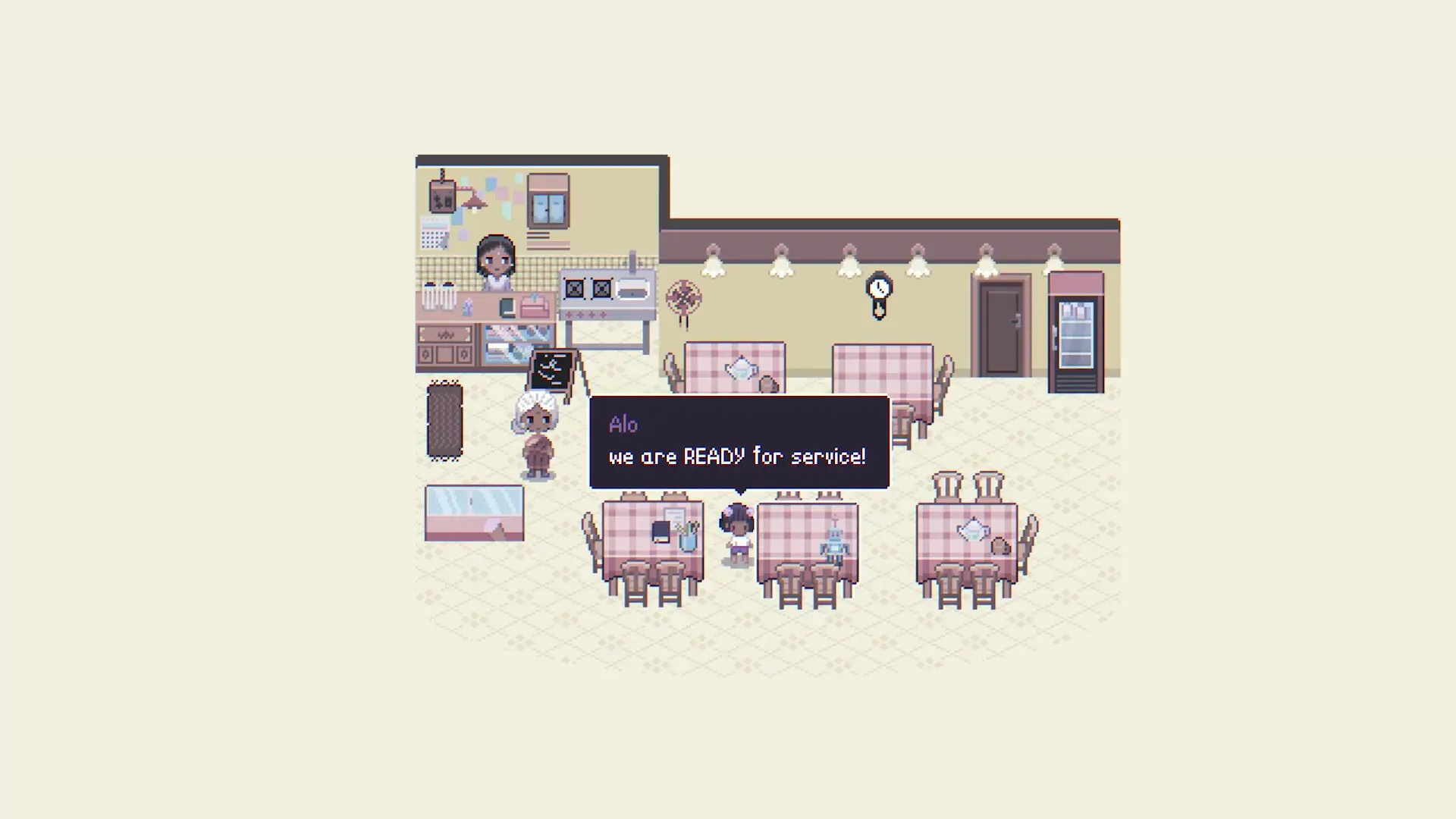
Alo has also, sadly, lost her grandmother recently. As you find out through flashbacks throughout the game, they had a very close relationship along with Alo’s mum and other family members. This grief is something ever present during your time with Fishbowl, and manifests in multiple ways. You soon get your grandmother’s possessions shipped to your apartment and diving into a box or two each day becomes part of your routine, finding trinkets like a chai thermos or her spectacle case. Each box has a specific item you’ll need to solve a small moving blocks puzzle to unearth, and these lead to bigger flashback sequences where you see little glimpses of life with Alo’s grandmother. They’re often very sweet, with young Alo running around with the energy of youth, while her grandmother teaches her about the world.
Routine is a big part of Fishbowl, and one of its strongest assets. Alo is clearly depressed, and understandably so considering the situation she’s found herself in, but Fishbowl uses routine to convey her mental state in a way I’ve not seen before. You’ll spend every day within the confines of her apartment, but completing certain tasks like brushing your teeth or feeding yourself help fill a bar at the top of the screen, which indicates her mental health. It’s really smart, as anyone who’s struggled with their own mental health before will know that simply having a shower every day can be an ordeal, so having to manually complete each element for Alo illustrates that struggle well. Each task comes with a small mini game; they’re never complex but you’ll be doing things like lifting the toilet lid, sitting and doomscrolling for a while then flushing and closing the lid. It helps you feel grounded in her apartment and makes it feel like these tasks are physically taking some effort for Alo to complete.

As you’re working remotely you’ll also need to do some of the video editing which got you hired in the first place, and this is another minigame that involves categorising coloured blocks as they come in from the right of the screen. You’ll need to match them to the corresponding colour section on the left of the screen and while they’re not difficult, they’re fun enough and I found myself enjoying them more as the game went on.
You’ll spend a lot of time having conversations in Fishbowl, particularly with family and friends. Again, reminding me of own lockdown experiences, Alo often takes multiple calls a day to her mother, cousins or even her elderly landlady. These are often bittersweet, covering sensitive subjects such as Alo’s mum’s shop scraping by or her friend’s struggle to source funding for the kids she teaches at school. You’ll choose how Alo responds to these conversations, with different options impacting her mental state. Be positive and you’ll feel positive. Even though you’re only interacting with these people through video calls you’ll still quickly build up a rapport with them all, savouring the small chats with co-workers before you start work, or actively wanting to call your mum to check in on her.
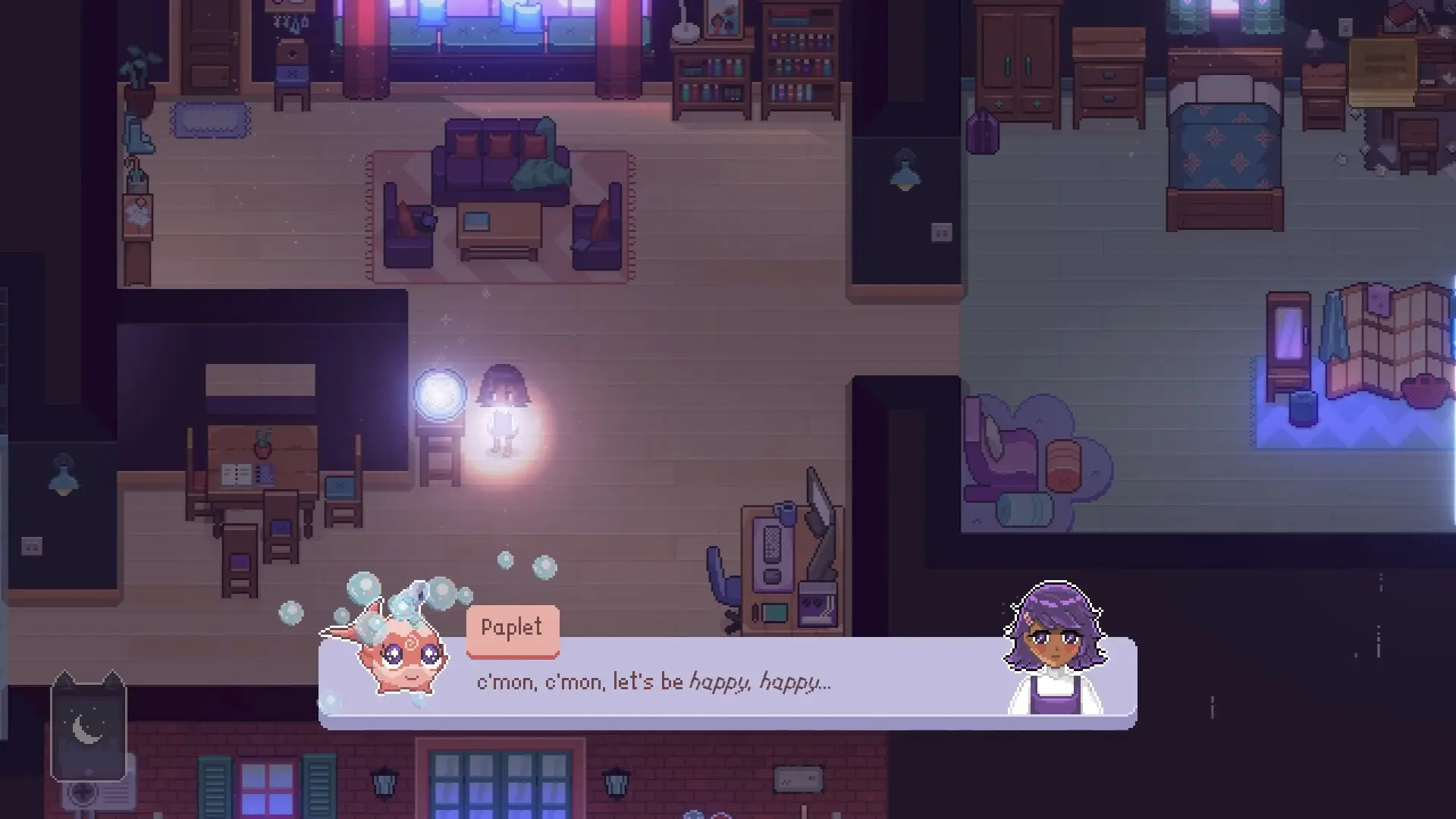
You’ll also regularly converse with Paplet, a mechanical fish you find among your Grandmother’s belongings. The fact that Alo so quickly believes the fish speaks to her isolation and the fragility of her mental state, and that compounds as the game progresses and she starts to doubt herself or see anomalies in her dreams that pull her back towards the depths of depression. Seeing that bar slip backwards after a day of caring for Alo really hits hard, and I just wanted to see her happy.
Fishbowl is a fascinating story, albeit one that some might find is told too slowly. Set over the course of a month, some days go by agonisingly slowly, especially when repeating the same daily tasks over and over. The setting and story can be a bit suffocating at times, but it’s by design and I think it needed to be that way to truly convey how Alo is feeling. If you can look past those two minor shortcomings you’ll find a moving story in Fishbowl starring a protagonist you just want to see smile again.