Spoiler warning: This article contains information about the critical path of Crimson Desert.
I was quite a way into Crimson Desert before I really started to think about the story. The world itself hooked me right away, and I threw myself into the starting quests without much consideration for why it was asking me to do anything. Playing as a reviewer pre-release I only had Pearl Abyss’ incredibly conservative 60-hour runtime estimate to go on, but that was enough to assure me that it would explain everything later.
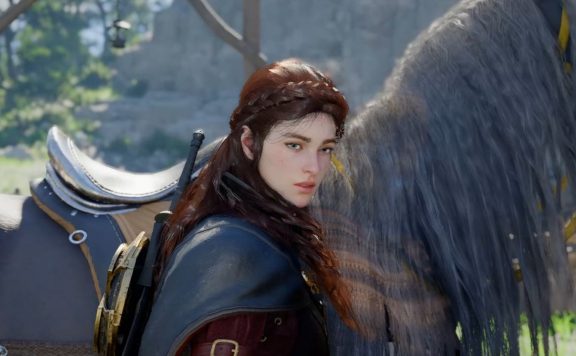
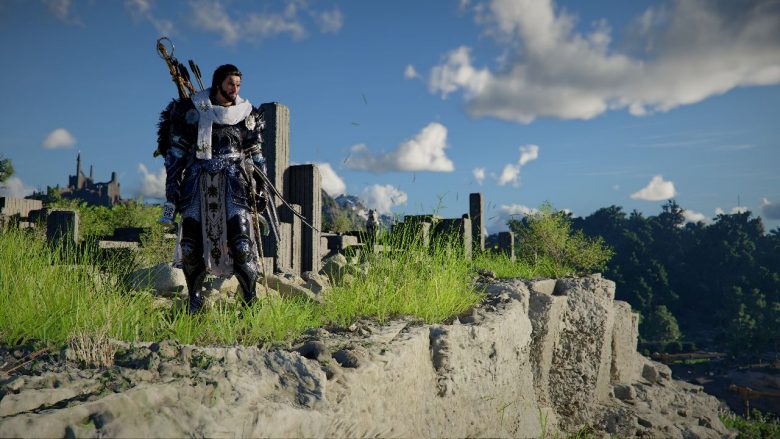
For now, I was Kliff, grumpy Scotsman and presumably second or third in command of the Greymanes, a Band of the Hawk-style mercenary group in violent competition with the Black Bears, a similarly themed mercenary group shown to be the bad guys because they all share the same three faces and don’t have any women. After being trounced by the Black Bears, Kliff gets his throat cut and is thrown into a river, visits a magical dimension in the sky called The Abyss, and is spat back out an unspecified amount of time later to basically stop some bad guys doing bad things.
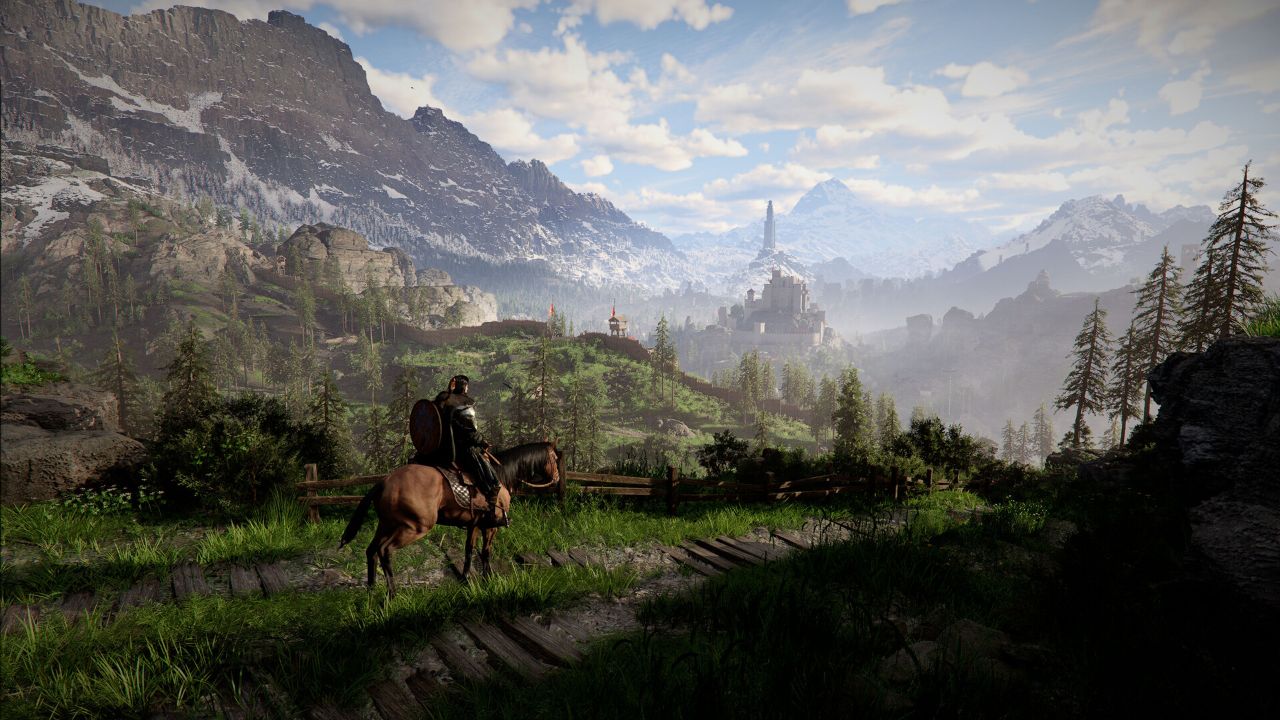
That’s all you get, and that’s all I needed at the time. Fine, I’m Kliff. I have great hair and piercing eyes and I already know I’m handy with a sword. Getting a horse minute-one already put Kliff several leagues above most open-world RPG protagonists so I was ready to crack on doing odd jobs for people in the “city” of Hernand (I put city in inverted commas because its about nine streets and a castle) until the plot finds me. And find me, it did, when I was directed to talk to a beggar for no apparent reason, then rescue a young lady from a sewer for no apparent reason (who didn’t need rescuing at all, by the way), and then clean a chimney so I can receive some new clothes that let me get into the castle. Also for no apparent reason.
And look, it’s not great. Twenty hours later it still wasn’t great, and by the time I was 150 hours deep and closing on the end of the narrative, I still couldn’t understand much of any of it. Basically, all the bad guys up to now that hadn’t died on-screen were coming together to open a Gate and usher through… something. That the established good guys didn’t want this to happen seemed reason enough to stop it. Kliff was on board, and so was I. When the “end” came and the game world didn’t so much as change its underpants as I ventured out to mop up the four and a half million gameplay challenges I had left, I just shrugged. I wanted to keep playing anyway, the bad guys were definitely dead, and I’d by now unlocked the option to switch to the other two characters at will and give everyone silly hair-dos.
But the point I’m sauntering vaguely towards is: who cares? Much noise has been made that Crimson Desert doesn’t have a great narrative, and they’re absolutely spot on. It doesn’t. It has its moments, some of which we’ll get into, and there are certainly the bones of a plot holding the sinews of the game together, but the actual story is disjointed at best, and nonsense at worst. It did get me thinking, though, about some other open-world RPGs (some of which were much better received at launch than Crimson Desert), and whether the over-arching narrative has ever really mattered in an open-world RPG.
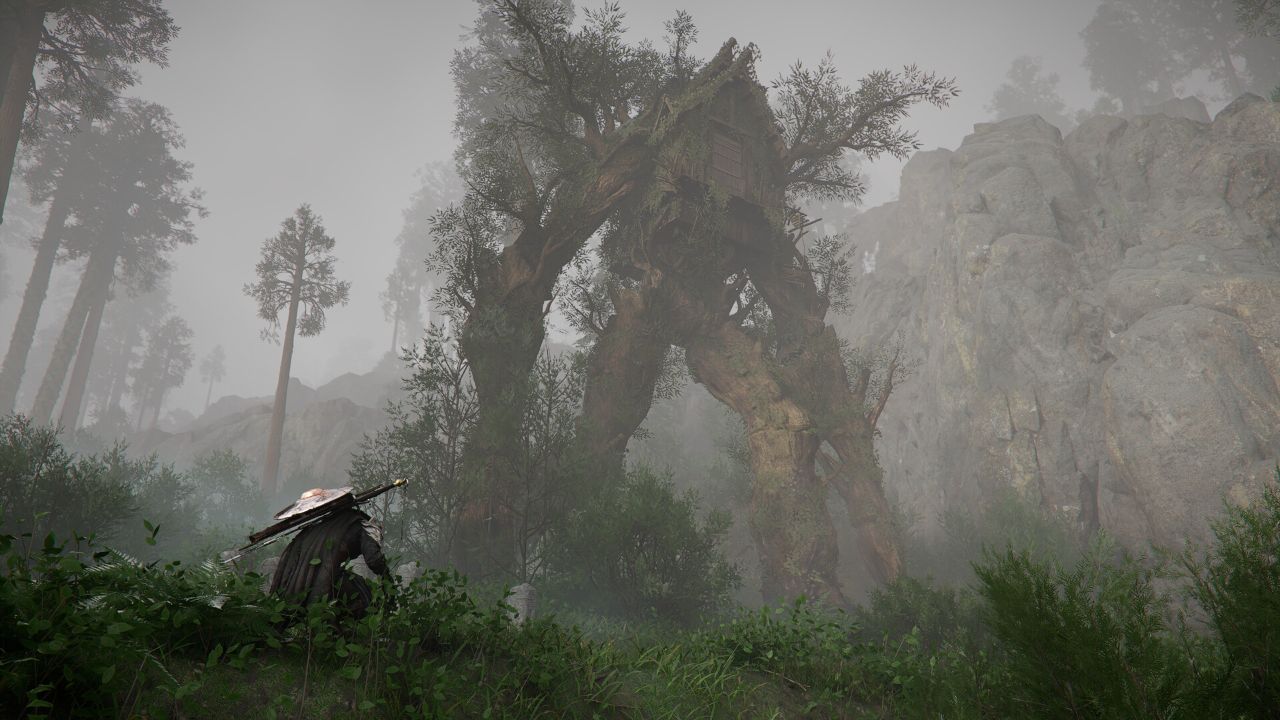
Because narrative, story, and storytelling are all very different disciplines. Narrative is what I’m hearing the most complaints about, because Crimson Desert has a bit of Capcom Narrative Syndrome, which requires that you first assemble a dozen or more exciting set-pieces, monologues, and boss fights, and then contrive to fill the gaps in between with reasons for the player to travel betwixt. I don’t think there’s all that much wrong with the writing of Crimson Desert overall; some of it’s quite funny, and though Kliff is a bit of a lump of wood there are some fun side quests and moments that at least give us a decent view of the world we’re in. The storytelling is no more obtuse or awkward than a FromSoft game, either, so there’s plenty of flavour text and background noise if you want to deep-dive the lore. In terms of narrative though, and how Crimson Desert gets us from A-to-B, I don’t think it’s any worse than almost any other open world RPG. And in fact, I don’t even think it really matters much in this genre.
Partly, the opening gambit is the issue for many. Generally speaking 99% of open world RPGs use one of four openings: you’ll be either one, an established character like, for example, Geralt of Rivia in The Witcher 3: The Wild Hunt, or Aran de Lira in Blades of Fire; two, a blank slate with an undisclosed murky past, as is often the case in the Elder Scrolls games; three, a young, untried pup who was recently orphaned and/or left for dead; or four, a plucky chosen one with talents as yet undiscovered – see Dragon’s Dogma and Two Worlds. Whether the character has a backstory or not rarely matters, as the only elements of the backstory that have any pertinence are the ones directly related to the events of the game you’re playing. Geralt is the primary exception to the rule here, since he has a string of friends and acquaintances who show up, but in the case of something like Skyrim you’d be led to believe you’re a six-foot newborn with a surprising grasp of swordplay.
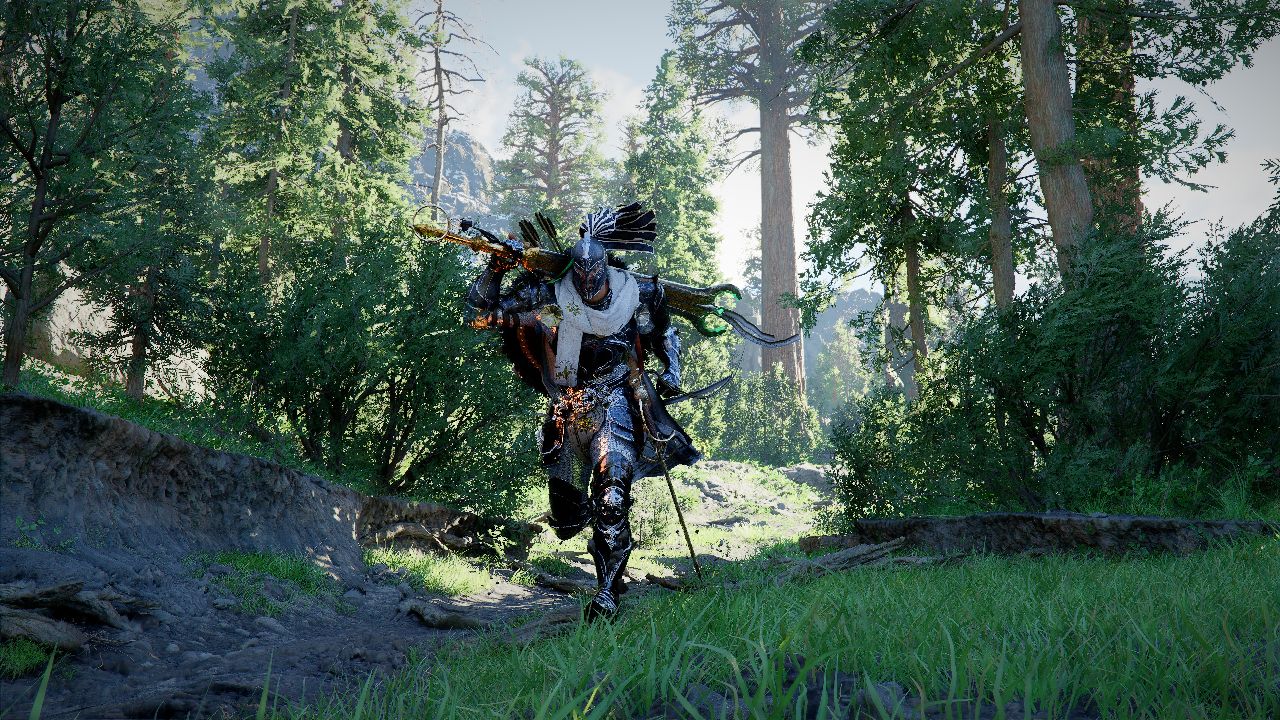
Whatever the call to adventure turns out to be, the next only-occasionally important thing is who you actually are. Again, The Witcher 3, Blades of Fire, and Crimson Desert pit you as the standard Grumpy White Dude of Legend, but of those three only The Witcher has a story that cares who you are. In fact, you’ll find The Witcher 3 is the exception that proves the majority of these arguments. Kliff in Crimson Desert, for example, could have easily been a created character, as his entire role in the story is to say “yes” to good guys and “no” to bad guys. That’s fine, of course; what more do you really need? Ultimately, even games with character choices like Dragon Age will boil down to “Sure I’ll save the world” or “Stop doing that, you villainous cur!”, often even if you choose the villainous route yourself.
Which is actually a detour worth taking for a moment. See, a lot of open world fantasy RPGs will have a morality system, but the better ones hide it and only reveal its effects in the way the world itself develops, like Dark Souls or Bloodborne quietly making themselves harder for the cruel of heart or slow of reflex. The problem is that even if there are evil things to do, often an RPG will deal with this in one of two ways: a crime system where you can simply pay enough gold to someone that they’ll completely gloss over the fact that you murdered an entire town because one of the NPCs blocked you in a doorway for eight seconds, or just give you a choice at the end to save everyone or damn everyone. Either way, the existence of that choice alone is yet another reason why the narrative plot takes a back seat in this genre.
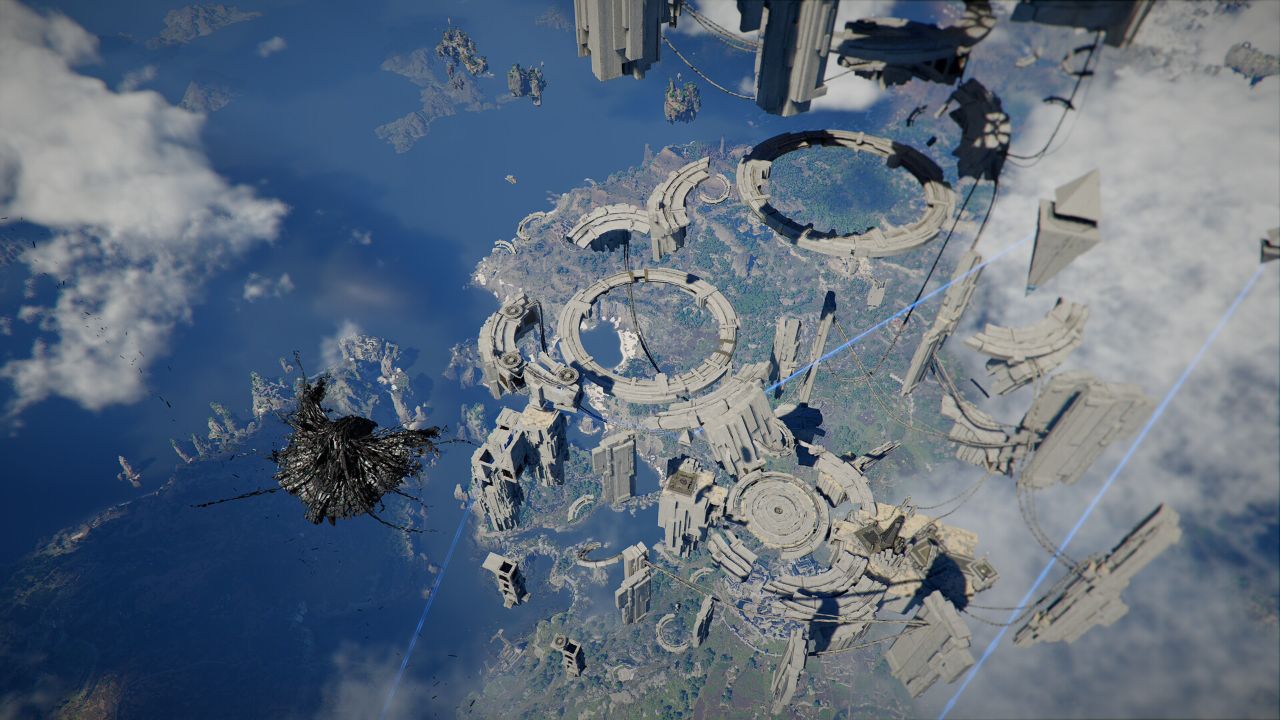
Circling back to the villains, let’s examine the fact that the vast majority of open world RPGs have an issue characterising the nemesis. Or nemesi, however you pluralise that. The Witcher 3’s world is characteristically morally grey, so you might even run into villains from previous games who are now kind of just getting on with their lives, no hard feelings, but the primary antagonist of the game is the titular Wild Hunt, a ghostly collective of otherworldly nasties who pop up for boss fights now and then and otherwise leave Geralt alone for most of the narrative.
Often, the actual villain is a posturing dick who exists so you’ve got something to put a sword through at the end, but who is also more of a puppet for something nebulous like “The Darkness” or “The Blight”. Sometimes, as is often the case in Dragon Age games, you’ll have a corrupt official or two to get rid of and a dragon to dice up at the end, but RPG villains are largely absent for one very glaring reason: if the plot was actually crucial, you wouldn’t have time for so much fucking about.
And this, to be honest, is the main reason the story is ancillary. In fact, I’ll bet that if you’re totally upfront with yourself and me right now, you probably can’t tell me what the actual story of Skyrim, The Witcher 3, Dragon’s Dogma, or Oblivion are. I bet you can give me the broad strokes; you’ll remember characters, set-pieces, and smaller chunks of self-contained story (everyone remembers the Bloody Baron quest in The Witcher 3 being really good, but I bet most of you can’t remember why it was really good). At the time, the story in these games might be enough to stir something in your chest when you’re not thumbing through cutscenes to get to the next treasure chest or boss fight, but you can’t tell me with a straight face that the plot of Skyrim or Dragon’s Dogma is what you remember most above fighting dragons or… actually that works for both examples.
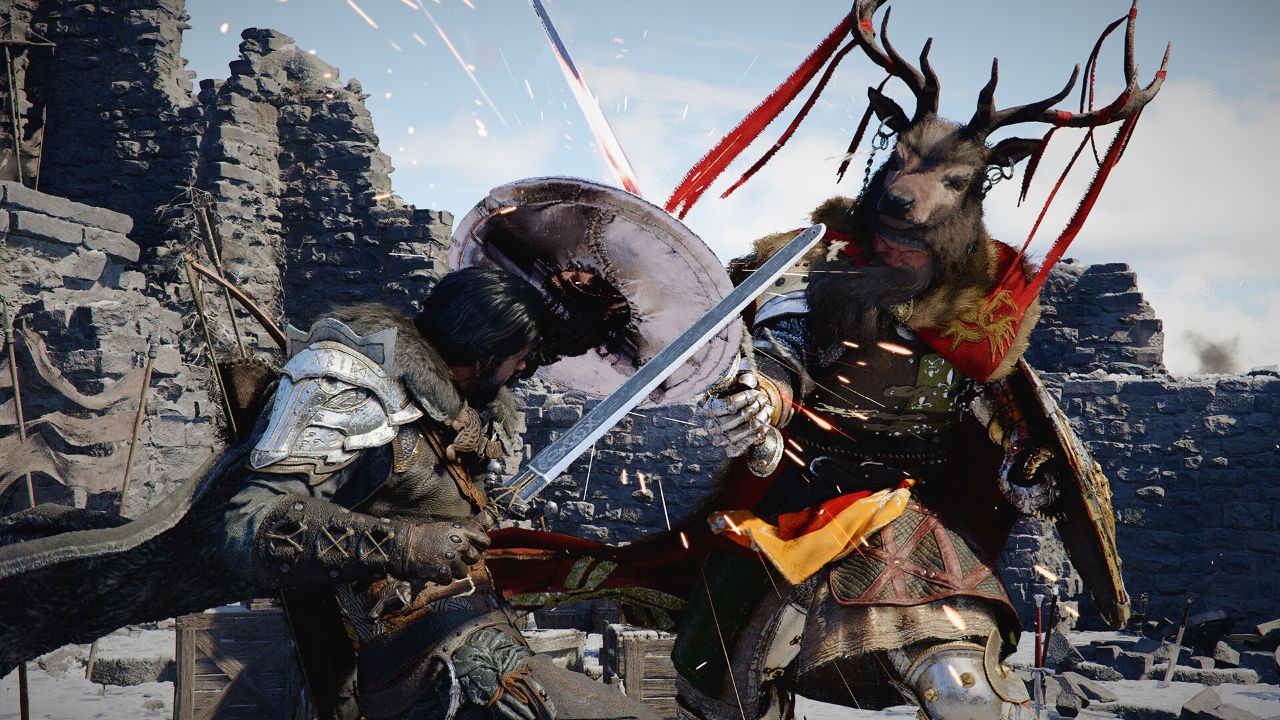
You see, the story has to be ancillary because you need to be able to abandon it for twenty hours of side-questing at a whim. It has to not be the most centralised focal point in case you rock up to an important cutscene wearing a dress with a created character who looks like Shrek painted himself purple and injected a bad batch of Botox. One of the few games that addresses this is Breath of the Wild, which sidesteps it by saying, “By all means head straight for Ganon at any time and end his reign of terror,” while knowing full well that you won’t unless you’re mental, but giving you the option anyway so it’s on you if you risk total Armageddon by pillaging all the ancient shrines first.
I’d argue that the real main story of Crimson Desert is Kliff reassembling the scattered Greymanes, with whom he has history and familiarity. They come together to re-establish their camp, setting out to do good deeds and help the people of Hernand because, I don’t know, it takes more effort to be a bunch of bastards? Either way, it’s this plotline that comes closest to delivering emotional stakes in a game world where everything you do is largely consequence-free.
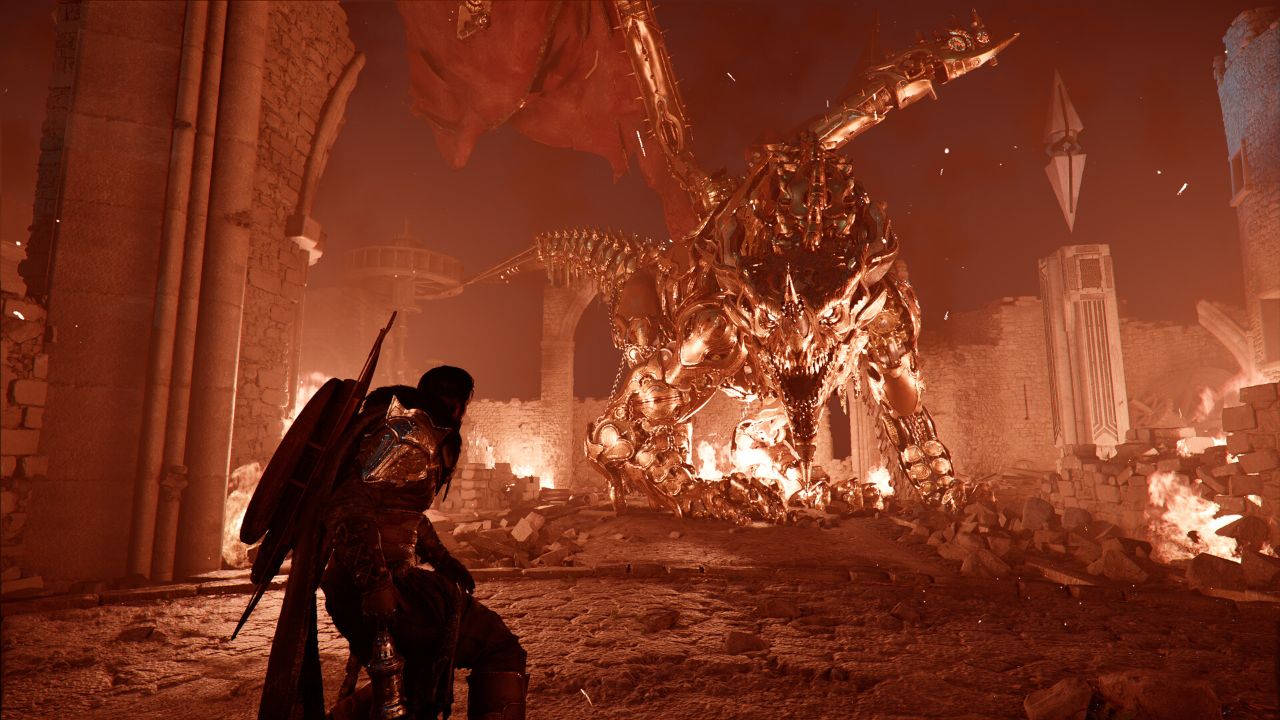
The point I’m making is not to defend Crimson Desert in particular. It’s plot really is loosely-connected nonsense in a world that makes little sense geopolitically or geographically, but so is the story of Skyrim, Dragon’s Dogma, and Dragon Age. They all rely on the same tropes for heroes and villains, all rely on the same mechanisms to pull you from biome to biome, so in every one your primary concern is going to a new place to either find something, kill something, or kill something so you can find something. Pretending that Crimson Desert does it any worse than most of the games in its genre (again, with the exception of a few, calm down) is being disingenuous. Any world-ending plot that you can abandon for an in-game month to go collecting ore, finding people’s lost paraphernalia, or unclogging their toilets or whatever, isn’t relying on story to sell units.
Importantly, though, that’s fine. You may well disagree with me, but being a fan of video game narrative in general, I don’t come to an open world RPG for the plot. I come for the world and the themes. I come for spectacle, and the kind of emotional pay off that comes from getting to know my party members or protagonist while the broader plot goes on in the background. I come for the little stories and the emergent stories, all of which every game on the list has to a lesser or greater degree, but dunking on an open-world RPG because the story isn’t delivered with the panache and pacing of the first three seasons of Game of Thrones hardly seems worth the effort.