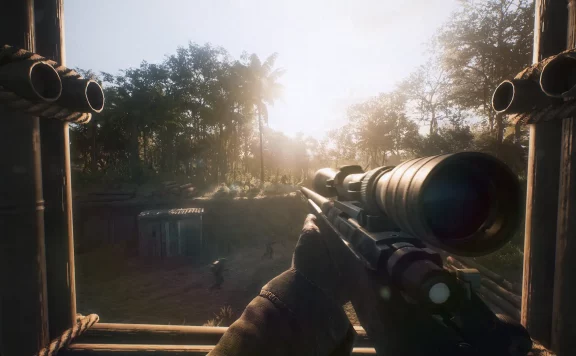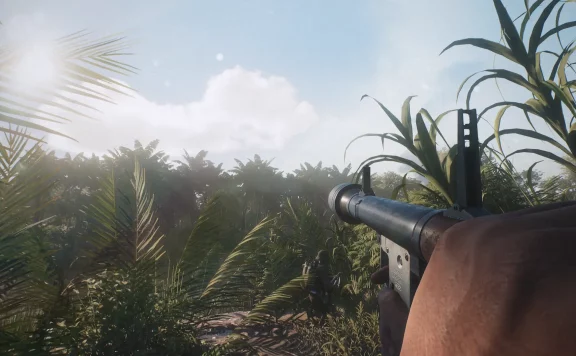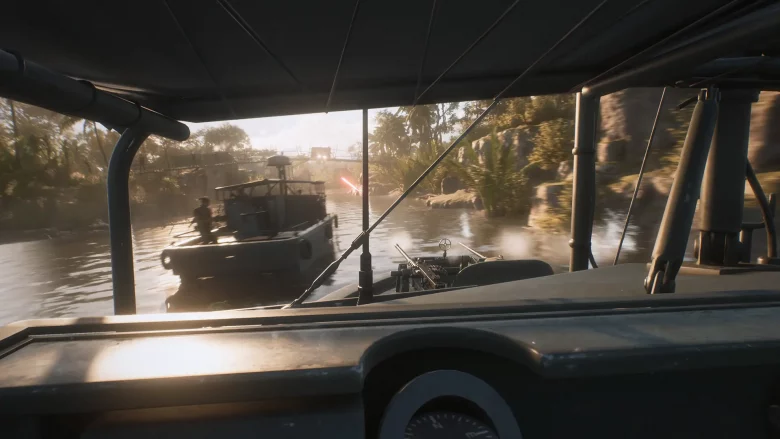
If, like me, you love a class-based shooter but Battlefield 6 doesn’t scratch that itch like it used to then you’ll be pleased to know that Hell Let Loose Vietnam is out now and promises to give you more classes than you’ll know what to do with.
A sequel to 2021’s Hell Let Loose, the latest entry takes you, unsurprisingly, to Vietnam in a series of intense 50 vs. 50 battles that’ll test your tactical and strategic vision as much as they will your aim.
We should have a full review of Hell Let Loose Vietnam on the site soon, but in the meantime I was lucky enough to have a few questions about the game answered by the developers. A big thanks to Expression Games, and to Paul Rustchynsky, Kieran D’Archambaud and Ryan Playle-Howard who took the time to answer these.
Q1: I saw that you chose Vietnam as the setting as it hasn’t been featured in any major games for many years. Did you go back to older titles like Battlefield Vietnam while researching the game?
Paul Rustchynsky (Rushy): We wanted to build a game that represented the events that took place, ensuring authenticity is front of mind – so we did a lot of research. It really is essential and the very first thing we do for anything within the game.
In terms of what areas we research, while films, books, or older titles can definitely be interesting for context, we want to always verify everything ourselves. A lot of these things can be super accurate, but we want to push further than that. So fundamentally, we want everything to be firsthand reports from people that were in the conflict.
Q2: Are there any differences between the two factions and the way they play?
Paul Rustchynsky (Rushy): The two sides are completely asymmetrical, so fighting as the NVA plays out very differently than fighting as the US. The NVA relies on a stealthy approach using a tunnel system, which gives them the ability to place down strategic plans and locations they can spawn and travel to.
In contrast, the US relies on air superiority, using transport and supply helicopters to move troops, drop supplies and manage logistics on a much larger and more visible scale. We’ve also got specific tools to help counterbalance these elements. For example, while the US have helicopters, the NVA have the ability to place anti-air guns in an attempt to take those down. The US helicopters have the ability to place supplies, and while the NVA have no such matching functionality other than boats that can travel through the waterways with supplies.
On top of that, all the loadouts, weapons, and grenades are unique to each side so that they feel and sound entirely different, which is awesome. It’s an exciting chance to embrace the fact that it is an imbalanced problem.
With this, balancing them is the single toughest challenge we face – we want the matches to remain fair even though the two sides are fundamentally distinct. So both sides are offering some of the same functionality, getting around the environment but in completely different ways.
Q3: What are your favourite new classes in the game?
Paul Rustchynsky (Rushy): It’s hard to select favourites, but I’d say I’m most excited to see how people engage with The Logistics Officer & the Helicopter Pilot. We saw some awesome skills in piloting over the Cross Play Playtest Weekend, which are particularly cool to see in action. But what I’m really keen to see is the tactical depth people playing in these positions bring to the table. It’s been great seeing the strategy that players employ. These roles are key to transporting infantry, delivering supplies, building garrisons, hunting tunnels, suppressing from above, spotting tanks – so their versatility and range is great. I’m really looking forward to seeing the community use them.

Q4: Were there any major learnings from the original game that impacted how you designed Vietnam?
Paul Rustchynsky (Rushy): One of our biggest takeaways was the necessity of a smoother onboarding process. There’s a steep learning curve to Hell Let Loose, which is part of its nature, but we wanted to address it in a way that gives every player an opportunity to play through a tutorial, which will give them the fundamentals right from the offset. Of course, beyond the basics, the complexity is still there and we allow players to specialise in the roles they want to play.
Kieran D’Archambaud: Another big shift we made in this title came from revisiting how we approach different platforms. Previously, PC and console versions had noticeable feature gaps, particularly around how players were able to join matches and party up with friends. Moving over to Unreal Engine 5 provided the perfect window to build a single, consistent feature set across every system, as we were able to strip back all that online infrastructure.
Paul Rustchynsky (Rushy): Interestingly, we originally assumed we’d keep PC and console quite separate like World War II, but following the update to Unreal and through the overhaul of infrastructure, we realised that actually we could offer the players the option to be able to play crossplay as well. So you can play PC against console if you want or you can choose not to.
Q5: How have you brought the feeling of guerilla warfare to life for the Vietnamese teams?
Paul Rustchynsky (Rushy): With Hell Let Loose: Vietnam we have focused on the military conflict as opposed to guerilla tactics commonly associated with the war. The NVA had specific strategies that we incorporated into the title such as tunneling. This will allow players to get a feel for their style of warfare and the asymmetry between the two sides, since it allows the NVA to really get around the environment in a completely unique way to the US.
We’ve developed the NVA’s and US gameplay mechanics to be fundamentally different, as it was of course an unbalanced situation – so both sides have gameplay mechanics that provide certain advantages over the other.
Ultimately, we have strived to replicate the feeling of each side with as much authenticity as we can – something we proudly apply to all our research and future development. As a result, we hope that players will experience the distinct ‘feeling’ of both sides in the title.
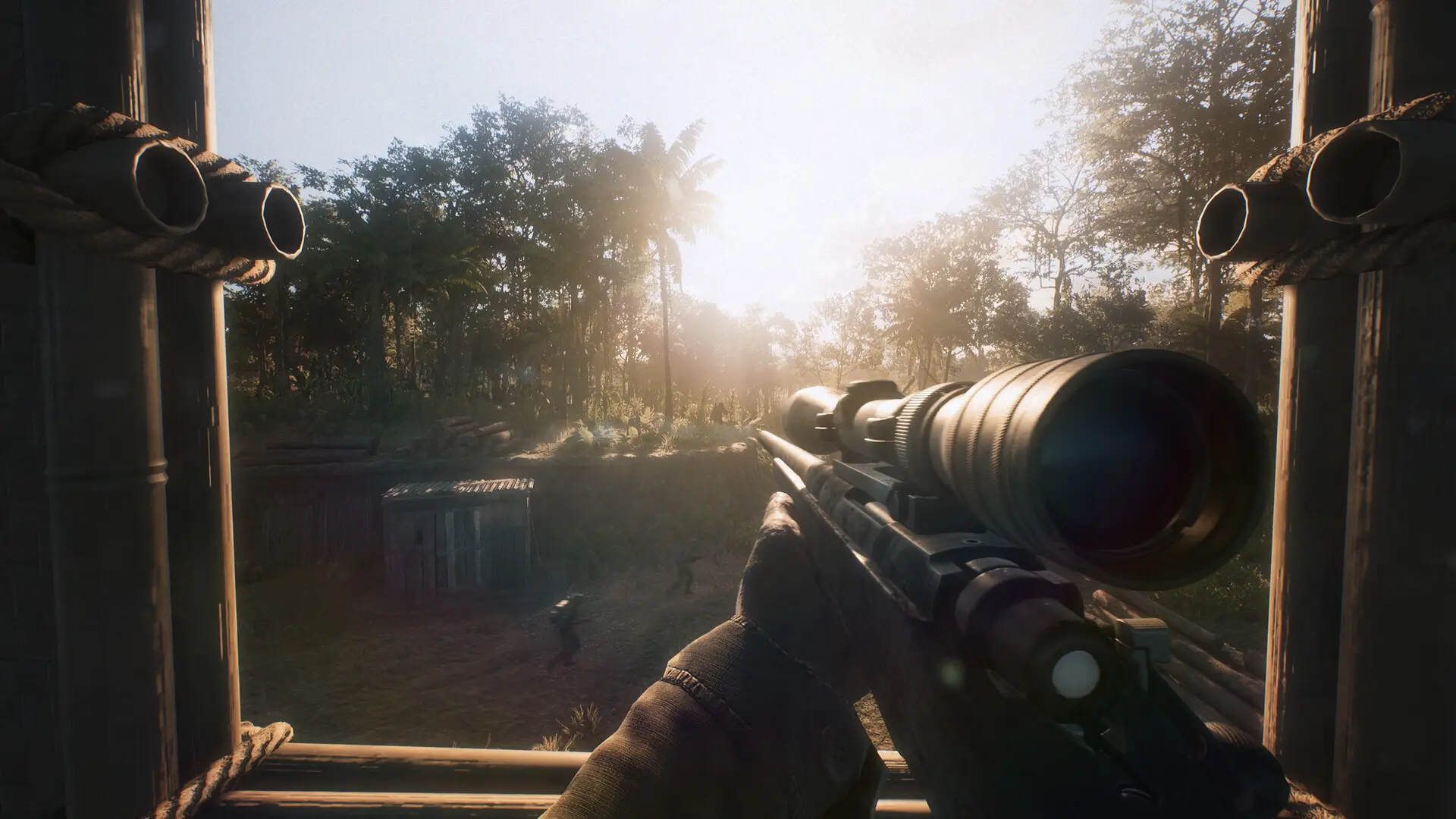
Q6: With the introduction of helicopters have the maps increased in scale?
Paul Rustchynsky (Rushy): Helicopters are our fastest and most versatile vehicles in the game, but the map sizes have intentionally remained the same scale from WW2 (which are already very large). Vertically the play space has increased, which ensures that helicopters have the room for evasion, and with this extra verticality we found it wasn’t necessary to increase the map size for the helicopter and doing so would have only slowed the pacing of the game on the ground.
Ryan Playle-Howard: Our maps are 2km x 2km with some additional perimeter for heli’s to turn and fly around. Given we have quite a diverse traversal methods in game, be it on foot, road vehicles or tanks, you can have too much room that can impact other ways of playing. Our game is about territory grabbing, defending and attacking those points, so space is only an issue if it isn’t properly utilised. Due to our game modes, everything is about capturing that 4km2 area and dominating the map. They can cross maps reasonably quickly – sub 1 minute, however we are in a biome that makes landing helicopters tricky, and keeping them safe even trickier.
Q7: How have real life battles and moments from the war influenced the new maps?
Paul Rustchynsky (Rushy): All of our maps are based on real events from the Vietnam War. We did extensive research to ensure that the conflicts we depict are as authentic as possible. Obviously the events that take place in these locations will play out differently in-game, as the outcomes are in the hands of the players, but there is real history behind where you are playing and the layouts of the maps.
Ryan Playle-Howard: We base all our maps on real world conflicts or strategic locations during the Vietnam conflict. There is a wealth of information we have accessible to us, be it journals or declassified documents, terrain maps, photography and real accounts from those that fought there. We try to replicate those to offer that authentic experience to the player but we also try to choose locations/battles that fit our core themes and pillars when making the game mode feel like a Hell Let Loose match. There is room in this game to stretch some logic to support the game, be it moving a river geographically to allow some of our boat gameplay, or adjusting the layout of a location to feel like it should but still play well. We are limited by the documentation and photographs taken to accurately match 1:1 some of the spaces but as long as the game is fun and it feels like it should then there is room to stretch the accuracy of our maps.
Hell Let Loose Vietnam is out now on PC, PS5 and Xbox.