
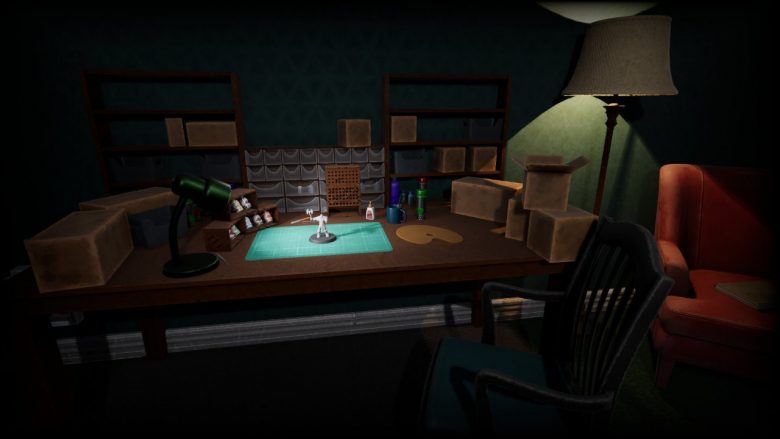
I’ve always had a bit of a thing for job sims. Bringing the mundane day-to-day to life in a way that makes it fun has a certain appeal, and when ever it adds a touch of insanity like, say, Surgeon Simulator, I’ll be there for a while. But really games like PowerWash Simulator or House Flipper are my jam. I like the relaxing motion of cleaning things and tidying up, and in the case of House Flipper I enjoy the creative element. The very concept of Miniature Painter Simulator was, therefore, an immediate draw for me. As a dedicated fan of Warhammer, I’ve painted hundreds of models in my time and I was curious to see how a video game could replicate that. Having now played Miniature Painter Simulator, I can confidently say that it can’t.
The first problem here may be in the concept, in retrospect. After all, sitting down to paint a mini is a hobby in of itself, and it’s a deeply personal and expressive thing. You may scoff, but it’s a form of art, and building, priming, and painting a model is something you get slightly better at each time. If you become dedicated, it’s not only therapeutic but rewarding as well. It’s hard for a videogame to capture that feeling in a simulator, because often simulators are designed to gamify things that are usually either boring, undesirable, or out of reach. For me, mini painting is none of these things. If I’m going to paint one, I’d rather just paint one on the desk behind me than paint a pretend one at the PC.
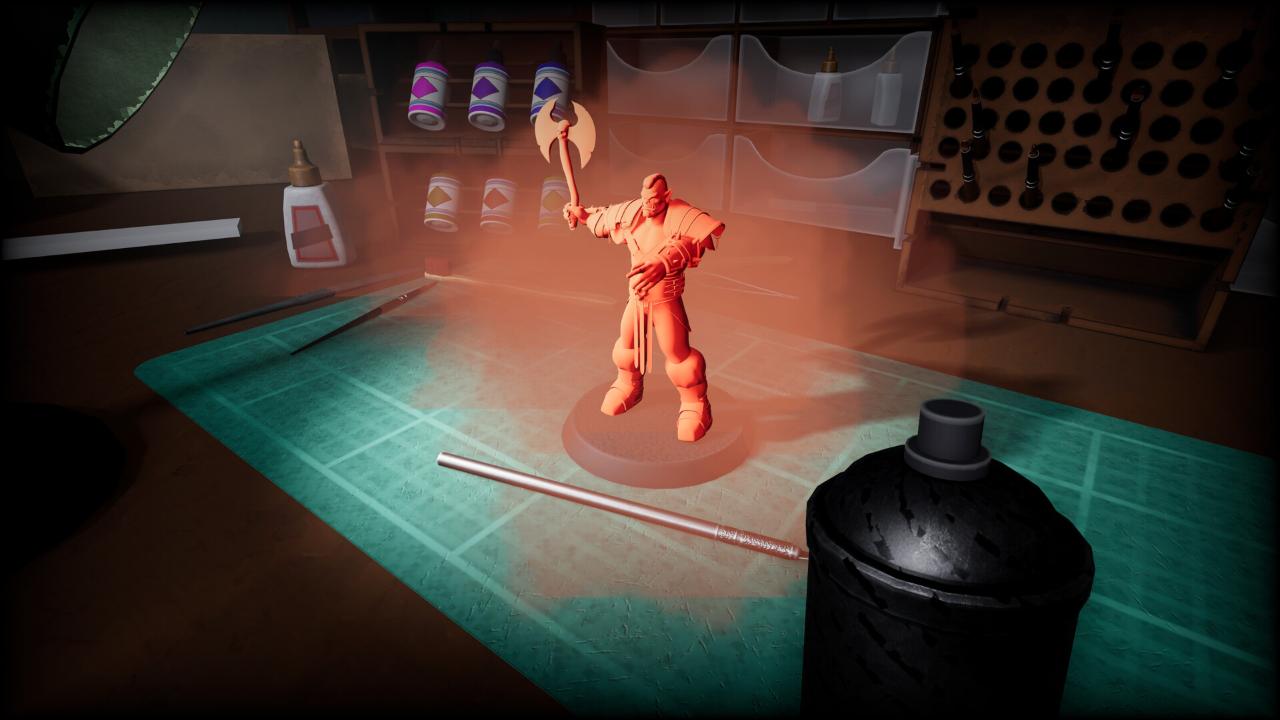
But the real issue here is the execution. Miniature Painter Simulator tells you at the top of the tutorial that the controls will seem weird at first. If I tell you it’s going to hurt when I jam a fork in your eye and then do it anyway, it still hurts – and you’re going to be less inclined to come to my next barbecue. The controls in this game are not just a bit weird, they’re outright unintuitive, clumsy and needlessly complex.
For a start, WASD is inverted for reasons I can’t fathom. You also can’t move the camera freely, you have to hold the mousewheel to strafe (not pan, which it tells you you’re doing) the camera. So simply moving the field of vision is an absolute pain. Next up, you can’t just pick up a mini and rotate it or inspect it, or even freely move one to a different place on the hobby space. Instead, you need to select an icon on a menu, and then use pointers on the mini piece to move, rotate, or inspect it. You can also warp the size of it if you like, which I genuinely can’t understand the need for.
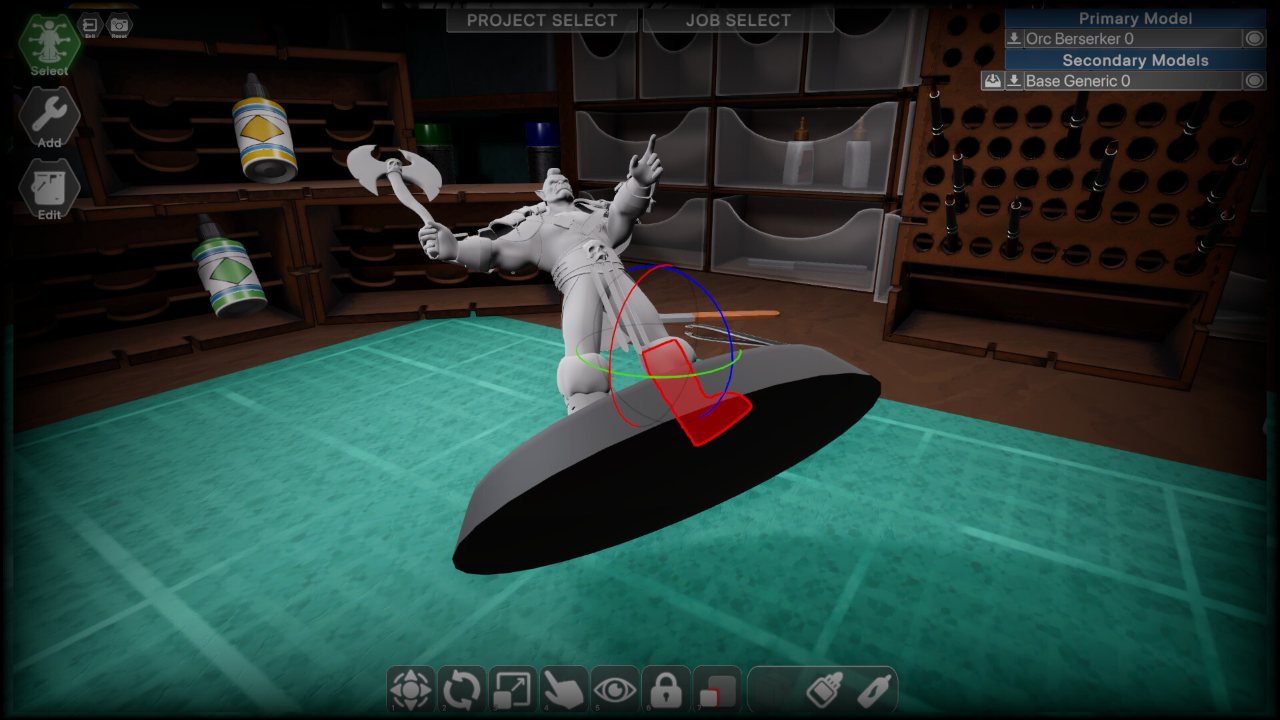
Something that should be simple is ridiculously clunky and frankly painful to use. It’s utterly pointless, as it doesn’t even recreate anything. If painting minis was this insanely clumsy in real life, you wouldn’t be able to do it all. Then there’s adding paints to your rack, which you do as you inspect the mini, rather than just having a rack of paints at your disposal that you can add to or mix; it starts empty and you add paints to it as you go.
Painting itself is more like colouring in with MS Paints, doesn’t feel relaxing or cathartic or even satisfying; you just wiggle the pointer over the mini with zero feedback until its covered. Gluing parts, which you can do before or after, is equally clunky and fiddly. There’s a lot promised in the final game, and the trailer still has my interest piqued even after playing. The idea of building countless models, painting them, adding shading and advanced techniques like OSL and NMM, then shipping them off to earn money is all very cool in theory. It just needs to be massively more intuitive and easy to approach than it is at this stage.
I understand the concept of this demo and was initially excited to try it, but the execution is just strange. It’s launching into early access and so there is plenty of time for everything to become more basically usable, but for now I’d only recommend this to those who have infinite patience and no access to real paints and minis.
Miniature Painter Simulator is published by Swain Games and set for release into early access in 2026. The demo is available now on Steam.