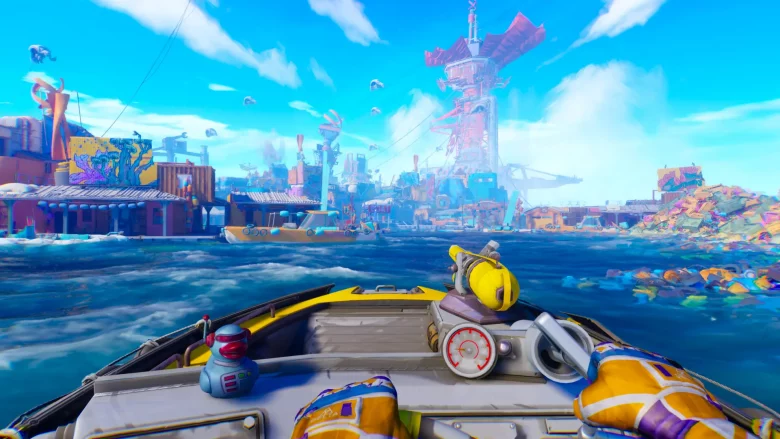
2021’s Road 96 was a surprise hit with me: a narrative adventure tackling themes of authoritarianism and national identity packaged up into digestible chunks full of charm and heart. While it was very heavy-handed in its approach to storytelling, it was hard not to fall in love with it. Developer DigixArt has tried to do the same with Tides of Tomorrow, expanding into a larger world and story, but unfortunately suffers from issues with its storytelling and mechanics that prevent it from capturing the same magic.
In Tides of Tomorrow, the world is on its last legs. The oceans are choked with plastic floating on the surface and spiralling down into the depths. The population is dwindling, down to a mere 300,000 survivors who largely live on floating platforms. Many are afflicted with Plastemia, a pollution-born disease that slowly turns the victim into plastic and that must be staved off with canisters of the equally scarce Ozen. You play an amnesiac Tidewalker: a person afflicted with Plastemia who can also see visions of the past, a key part of the game’s core mechanics.

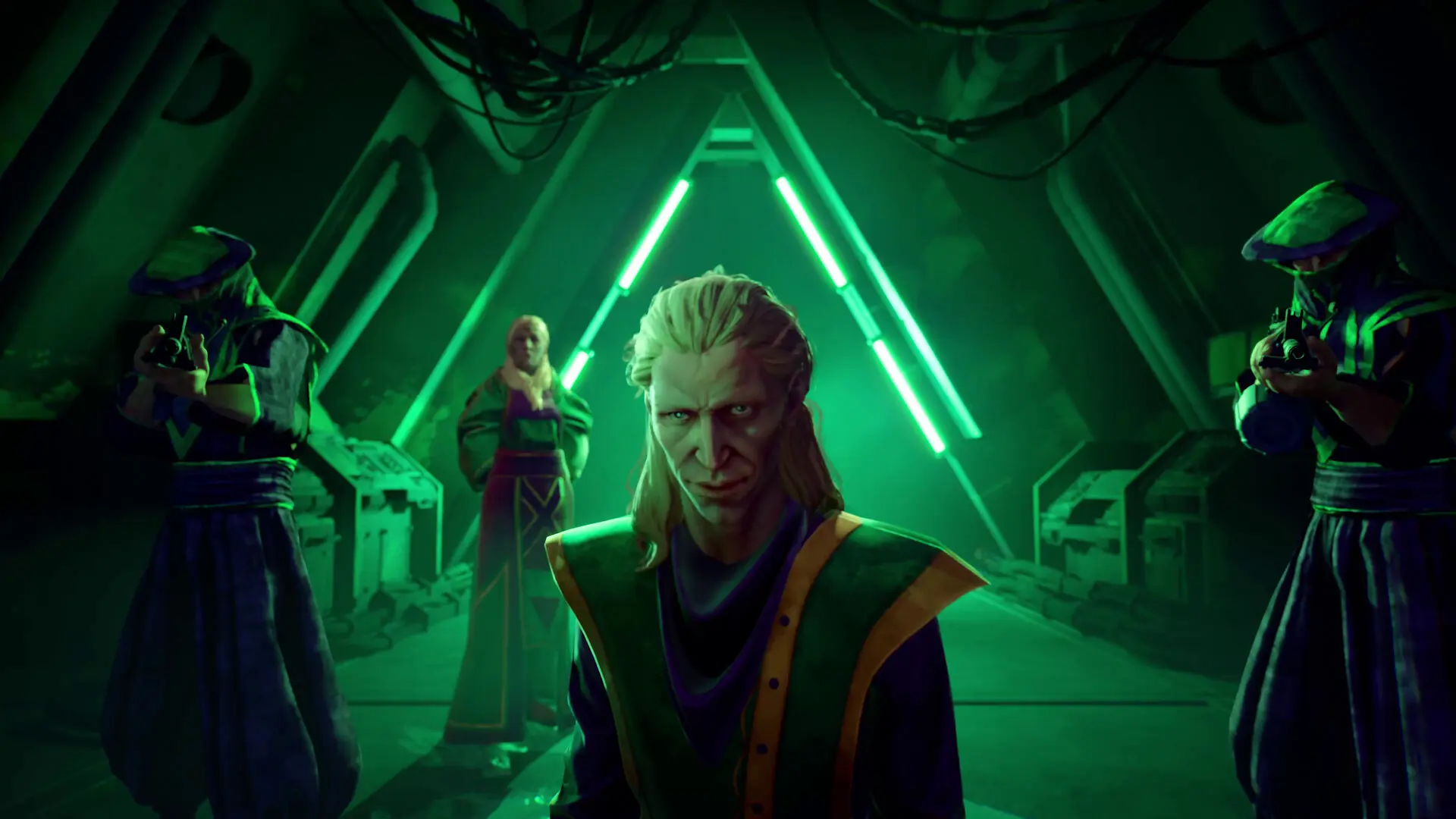
What follows is a 10+ hour story that introduces you to 3 warring factions: the hedonistic Reclaimers, the Marauders, who control the Ozen flow, and the prophecy-following Mystics. You’ll be travelling back and forth between their homes, meeting a cast of characters, building relationships and trying to work with everyone to shape a future, whether that’s for mankind, Mother Nature or just yourself.
It’s an interesting set-up but takes itself too seriously. Pollution, environmentalism and the health of our planet and the creatures living on it are heavy topics, but where Road 96 tackled similarly deep themes with a sprinkle of humour and a cast of characters so full of charm you couldn’t help love them, Tides of Tomorrow is markedly more po-faced. Characters aren’t particularly fun, or even likable at times and you’re constantly beaten over the head with “the planet is dying” messaging, whether you’re watching people decay into plastic or playing ecoterrorist and literally saving the whales. It very quickly feels exhausting and makes it difficult for me to engage in the few personal stories I was actually invested in, like Eyla’s quest to save the Mereids, the mystical sea creatures that can survive the plastic-filled seas.
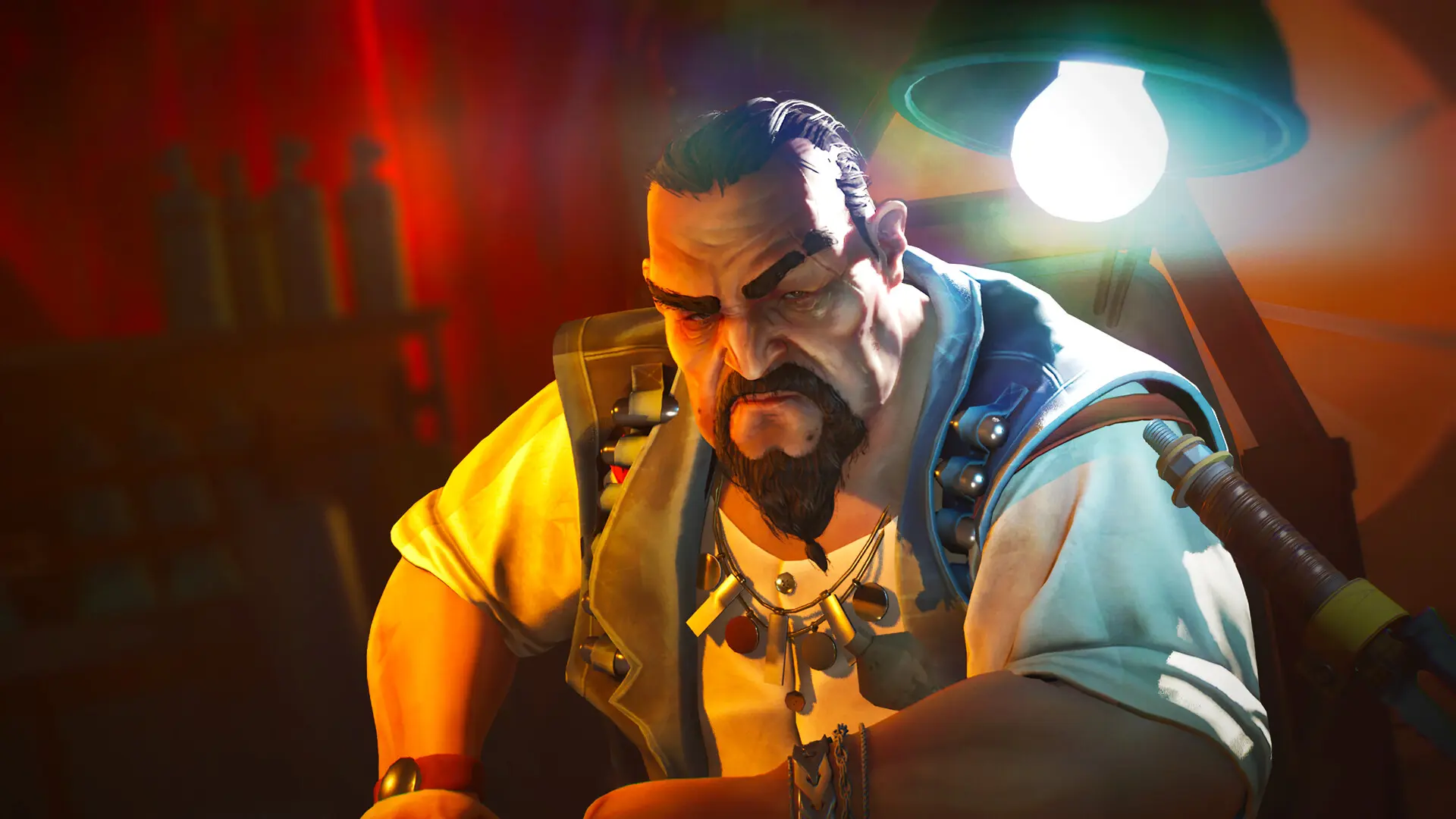
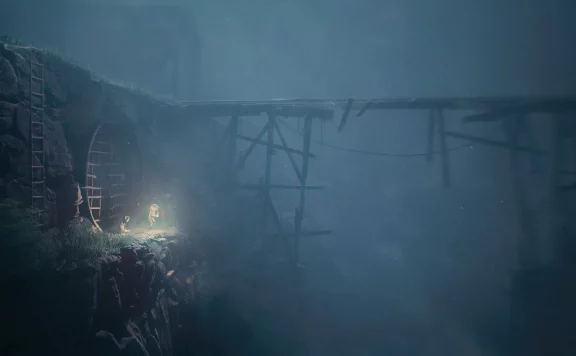
Despite being a narrative adventure, you’d be hard pressed to call Tides of Tomorrow a walking simulator. There’s lots to get stuck into here, including piloting a rather zippy little boat, sneaking around restricted areas using some basic but functional stealth, and running and jumping your way out of dangerous situations. A lot of the gameplay elements are contextual: you won’t be jumping unless there’s a ledge to jump from and to, and while they work well enough, they were never something that particularly excited me despite the variety that presents itself throughout the game.
While the story of Tides of Tomorrow is very much your own, you’re not technically alone in writing it. At the start of the game you pick a player to “follow”: you’ll see a list of other players who have played the game, tagged based on their playstyles, and your playthrough directly follows theirs. For example, someone tagged as a survivalist is likely to be quite selfish when it comes to supplies, such as Ozen or the scrap used as currency. By following a survivalist you may find that resources are hard to come by as they’ve hoovered them all up on their playthrough. There are drop boxes dotted around where you can choose to leave items for the next player, and what you’ll find is based on the player you’re following.

Decisions the previous player made will impact your instance of the game too: if they fixed a ladder in a stealth section you’ll find it’s already fixed in your playthrough so you can climb up and over the enemy guards. There are larger story ramifications too, as the way they behaved during key moments will make things easier or more difficult for you, so you may arrive somewhere and find you need to sneak in as everyone’s already angry at Tidewalkers. You can also use your Tidewalker vision mode to look for echoes of the past player as you move through the world, which helps you listen into conversations they had previously that unlock new dialogue options for you or show routes through the environment you may not have noticed.
It’s a neat system, although I’m not sure it makes narrative (or even logical) sense at times. You’ll arrive in town and a guard is distrustful because the previous Tidewalker tricked them, but then they’ll do the exact same thing again as you use a vision of the past to learn the same way to trick them. At times it feels like a weird mashup of multiverse and timeloop theories, but without anyone really acknowledging these things. Still, push those thoughts out of your head and it’s easy to get swept up in the role the past plays in your present.

This system can also, however, damage immersion, as references to the previous player’s choices are shown constantly, in both the UI and the dialogue. At one point I was following what I assume was a playtester, with a name like “eoeofjs-EUR02”, and seeing that everywhere really took me out of the game. If you’re playing the game and following me then I can only apologise if my PSN name, “mcsmellington”, is undermining the serious story the game is trying to tell.
Still, it’s a cool idea and in a shorter game I think it’d make for a fun way to enjoy multiple playthroughs of the game. You could follow the pro-mankind or pro-nature routes, help or hinder future players and see more of the story variations they’ve thoughtfully included. At 10 hours though, it felt too long for me to want to go back more than once, considering the mechanics take a backseat to the narrative. The story meanders in places, and later in the game it felt quite clear what route I was going down but didn’t seem to be able to do much to change it. It wasn’t a “bad” ending, and truthfully I was actually quite pleased with it, but it would have been nice to have done more to impact some of those late-game decisions.
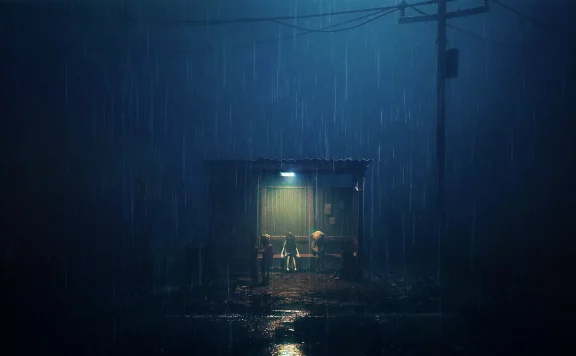
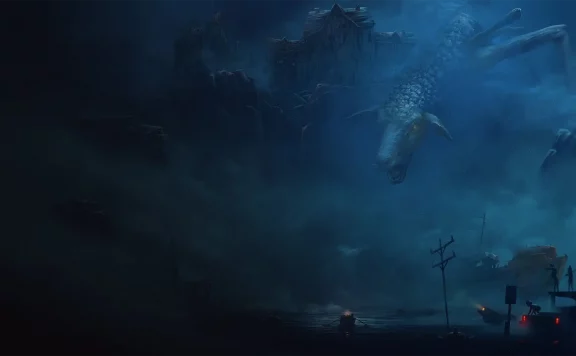
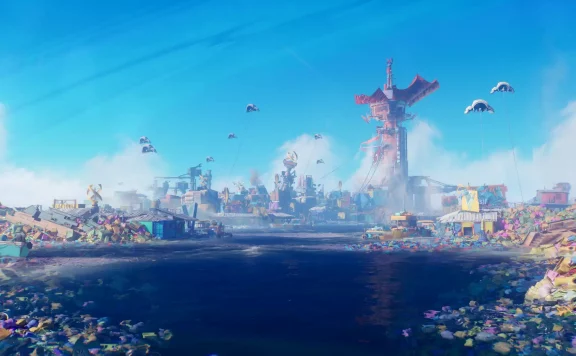
Visually it’s quite a striking game, with so much of it being set at sea but with environments made out of trash and scrap. It’s bright and vibrant which contrasts nicely with the story’s focus on pollution and destruction.
The game’s depiction of Plastemia is particularly good, with a strangely beautiful look to this deadly disease, as characters are veined with hues of purple and green. I really liked the music too, and in-keeping with the ecological themes of the game, a lot of the music feels like something you’d hear in a hippy drum circle, in the best way.
Connecting your playthrough in Tides of Tomorrow directly to that of the player before you is an undeniably clever way of hinting that we all need to think about preserving the planet for future generations. That doesn’t change the fact that Tides of Tomorrow unfortunately left me feeling frustrated at times due to heavy-handed storytelling, simplistic mechanics and a loss of immersion caused by its own standout mechanic.