Saros is a hard game. I’ll make no bones about it and accept no comments to the contrary. Returnal, Housemarque’s last game, had me on the ropes a few times, and what kept me coming back then is the same thing that keeps me coming back to Saros, despite the steep challenge: curiosity.
But where Selene’s story focused on her solo struggles to overcome a planet of limitless hostility, it was ultimately undone by the ending, which pulled the rug out from under me and made me feel that the last twenty hours I’d spent were wasted. You can interpret it however you like, but the true ending to Returnal soured me on the game as a whole, despite falling in love with the mechanics.
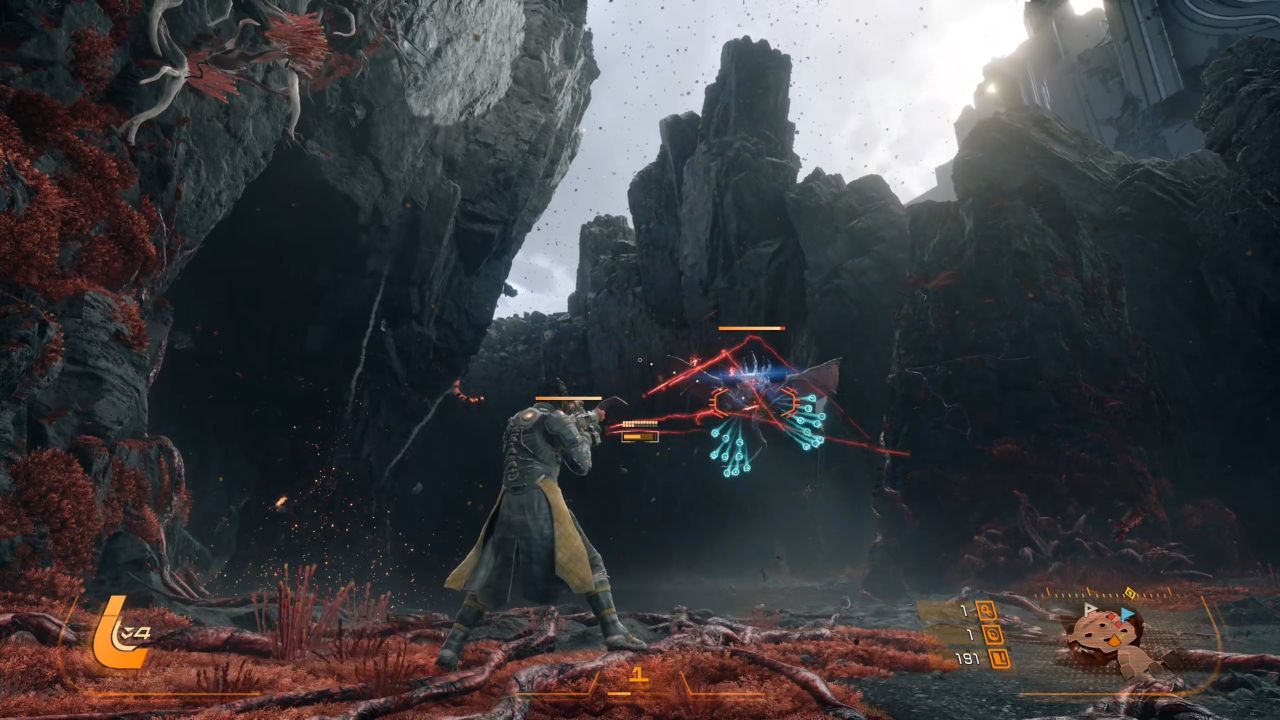
Does Saros do the same? Do you really think I’m going to tell you that in a review? The truth is, though, that Saros is both very similar and very different to Returnal. It’s similar because it features the same kind of frantic, relentless bullet-hell gameplay across a barren but hostile alien world. It even features the same kind of existential mystery at its heart; but it’s different because it focuses not on a sole survivor but on an explorer striving to find the last remnants of humanity scattered around a dangerous world.
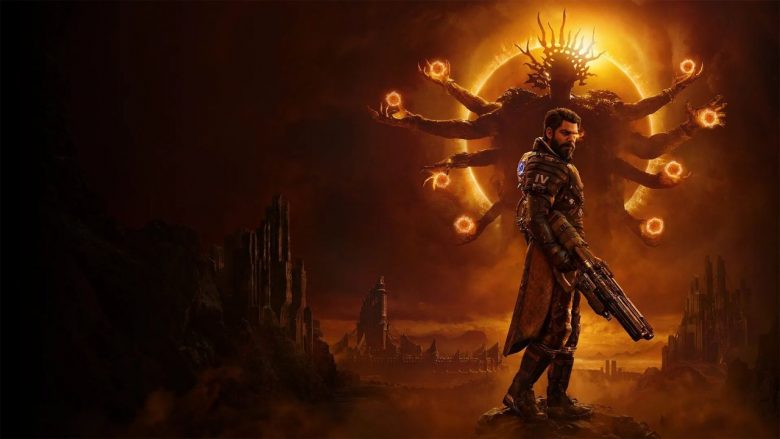
As Arjun Devraj, played with grit-toothed stoicism by British actor Rahul Kohli, you must venture out into the ever-changing terrain of Carcosa in search of the colonists of the lost Echelon missions. As an enforcer of Echelon IV, Arjun is highly trained and more than capable, but Carcosa is a world of biomechanical horrors and mind-bending illusion, that plays with his mind and pushes his physical limits at every turn. Each death sees him spat back to the base, stronger thanks to the superb progression system, and more determined.
Arjun works for Soltari, a deep space corporation that makes Weyland Yutani look like the Salvation Army. Headed up by a ruthlessly efficient AI named Primary, Arjun’s team of burned-out specialists struggles to hold it together as the world continues to play tricks on them. As the story opens, Carcosa has already claimed many lives and minds, and those who remain are paranoid and strung-out. It makes for an interesting group dynamic as your allies slowly unravel before your eyes, and you can never be sure Arjun’s perspective can be trusted either.
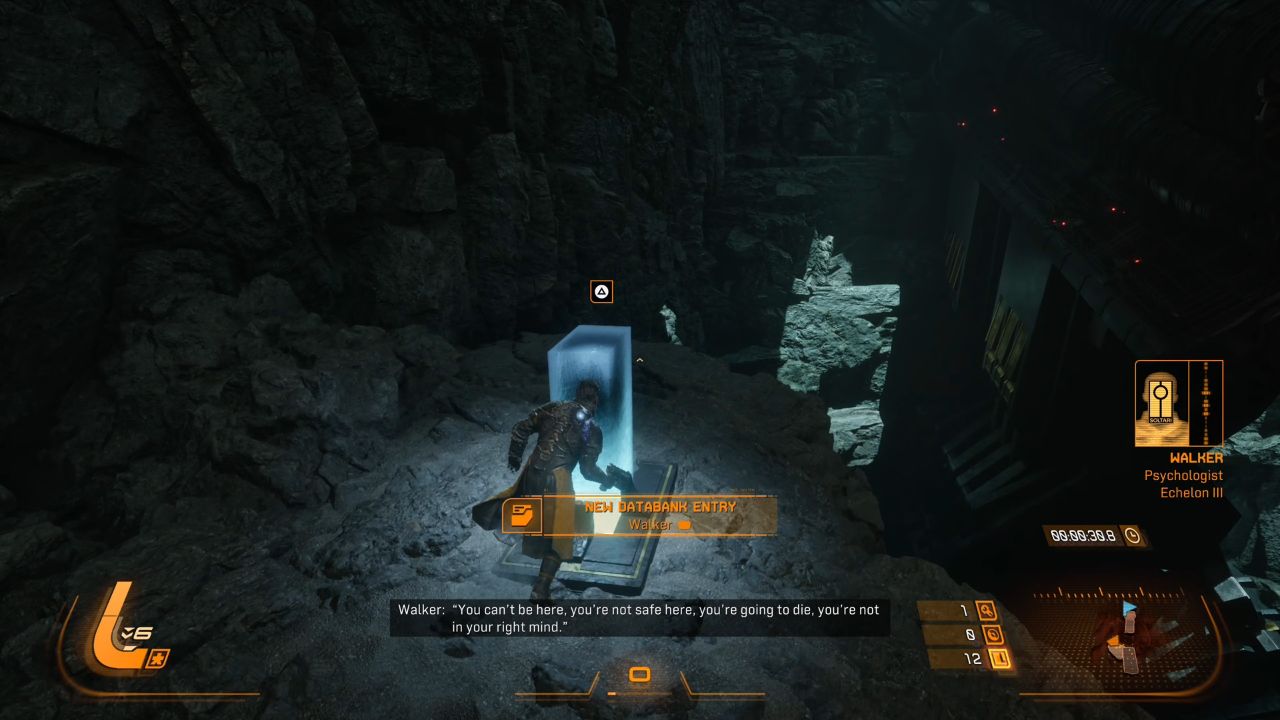
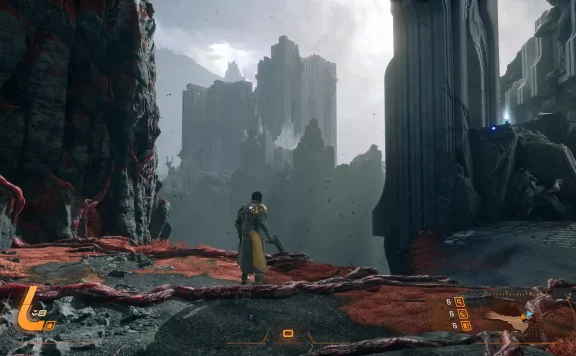
What’s easier to understand but much harder to contend with is the world itself. Head out into Carcosa and you’ll find an alien hellscape of ancient ruins, plasma-based death traps, and legions of biomechanical monstrosities intent on killing you. There’s nothing to reason with or navigate around here; everything you meet wants you dead. Enemies attack with physical power, as well as colour-coded plasma and laser weapons that you’ll need to dodge around with Arjun’s powered dash or block and absorb with his shield. Blocking and dealing damage to enemies charges Arjun’s heavy attack, which can do massive damage to enemies.
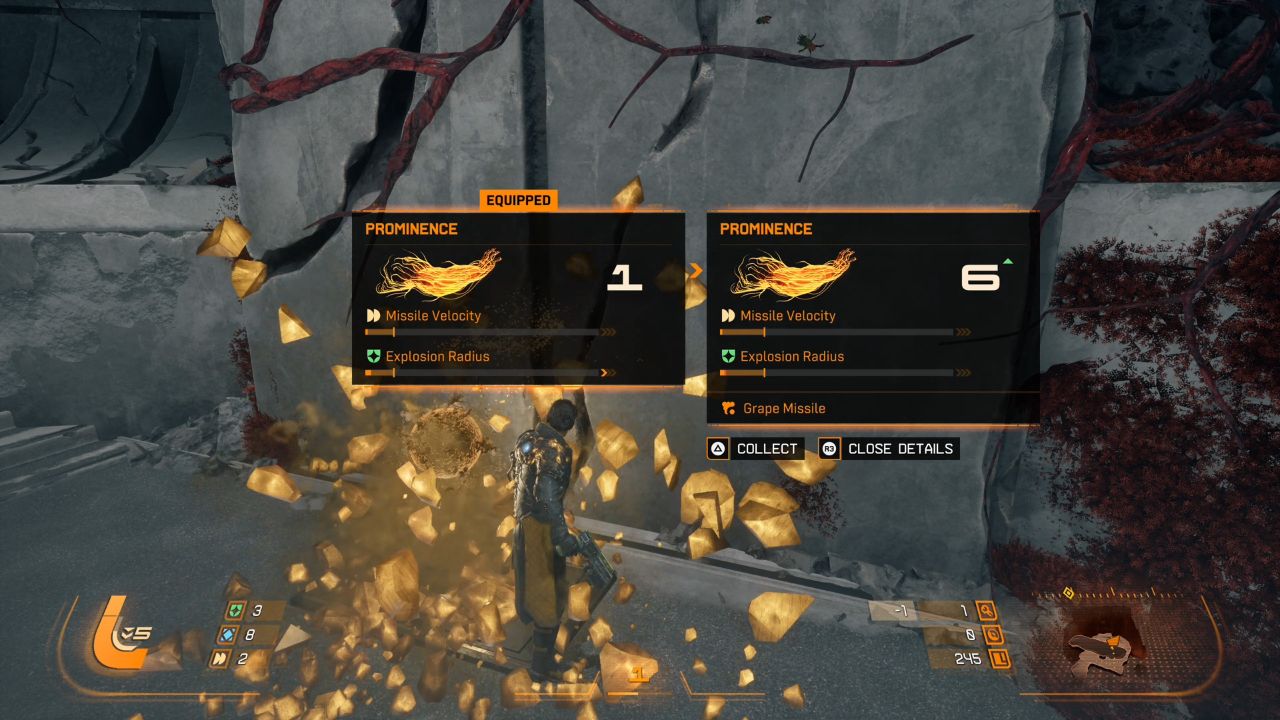
As the story progresses you’ll unlock several tools including a grappling move to cross gaps and the ability to use jump points to gain height. Your shield will gain strength to absorb corrupted projectiles, and Arjun will develop a huge arsenal of weapons to be randomly doled out each run. As with many roguelikes, Returnal included, success can sometimes hinge on which weapons and power-ups you luck into in a given run, but Saros puts more emphasis on increasing Arjun’s innate stats.
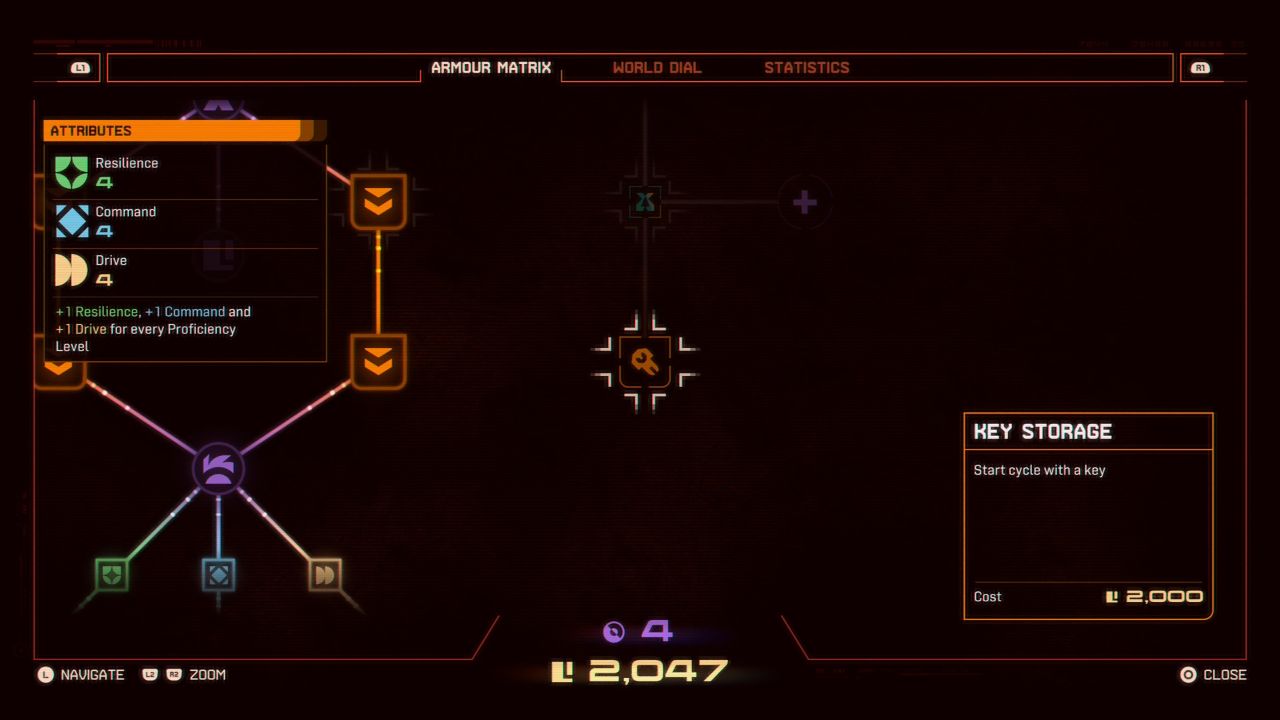
Respectively: Resilience, Power, and Drive determine his hardiness, ability to absorb energy and deal damage with it, and how much currency you earn each run. Earning the currency, known as Lucenite, is essential, as it unlocks nodes on the frankly massive skill tree, which upgrades your stats permanently, and uses a secondary (less frequently found) currency called Halcyon to add abilities to Arjun’s enforcer armour, like increased healing effectiveness or even a Second Chance upgrade that brings you back after a death.
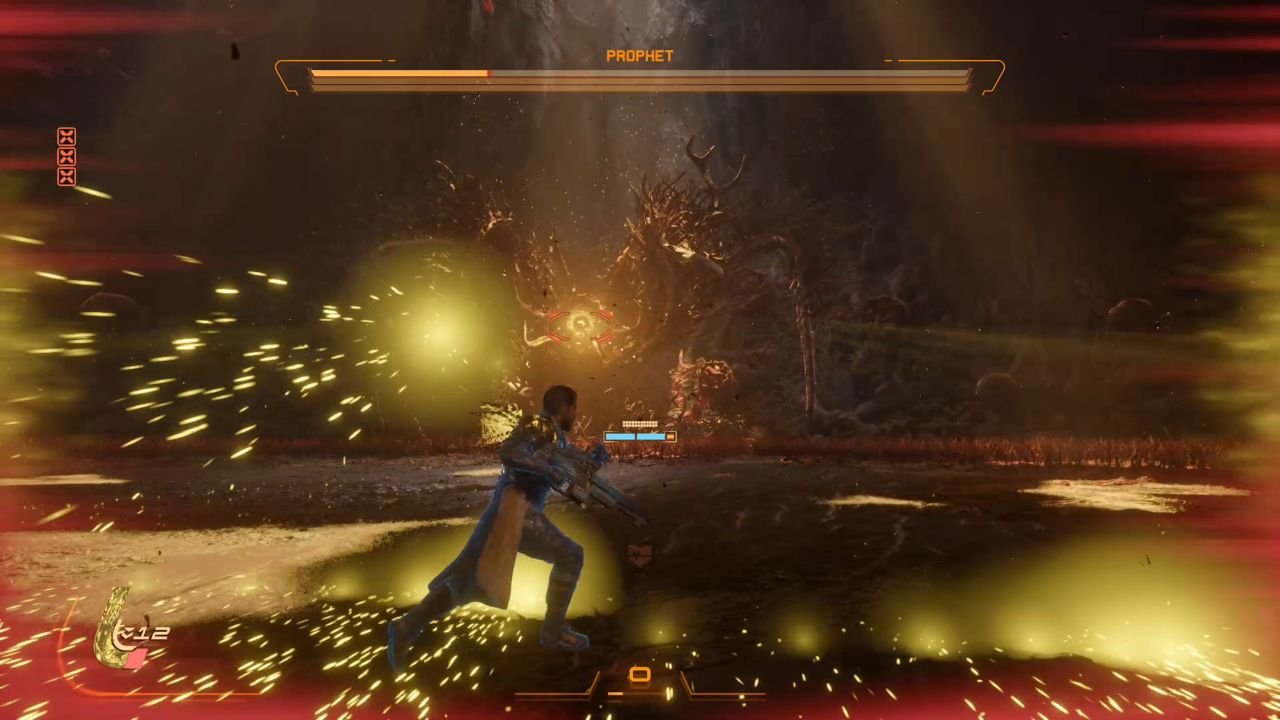
Every run randomises the world as you enter it, up to a point. When you get so far the world will align with previous incarnations so you can start to learn your way around, and you’ll usually need to unlock a specific path or complete various objectives to unlock the way to a boss fight, which will remain open for subsequent runs. It has to do this in order to balance out some of the challenge, because Saros does not hold back.
Enemy spawns are random, and some kind of sadistic RNG-based director will throw all sorts at you at once, spawning enemies in groups even as you fight against the existing ones. Because you don’t know what’s coming, it’s hard to predict or plan any kind of strategy. It’s a game of skill and reflex that doesn’t let up during combat encounters.
Each of the main areas also has a point where you must activate the Eclipse to continue, which changes the world state, making enemies more aggressive and powerful, but increasing Arjun’s currency rewards. In this state, the power-ups you collect also come with negative modifiers, meaning you’ll need to choose carefully before selecting them.
It’s hard to overstate the level of challenge Saros brings in its default state, and it really feels like a game built for the hardcore player. It requires acutely fast reflexes, the juggling of multiple moves and abilities, and the good judgement to know which skill, weapon, ability, and items to take or collect in the field. But it also requires you to learn the enemy, as even the lowliest spawns can kill you in a few direct hits. Death never feels like a harsh punishment, but when 20-to-30-minute runs can end because of a few clumsy mistakes it can feel frustrating nonetheless. I should add that Saros does allow difficulty adjustment, which it states in the menus but doesn’t actually explain.
It’s a bit of a convoluted system, to be honest, and some players will simply bounce off before they even find out it exists, but know that if you’re finding things too tough, there is a way around it to a degree. Likewise, if you’re the kind of person who takes to social media to complain about hard games being too easy, there are modifiers to make it even more brutal. Frankly, the challenges you can manually add to the experience are going to challenge even the most braggadocios of git gud-ers.
Saros is beautiful in motion though. Arjun charges through levels with incredible speed and precision, often relying on auto-tracking weapons to deal damage while you dodge projectiles. Each stage looks and feels very different from the last, with some dazzling colour palettes on display. It sounds great too, not least because of the superb VO work by the cast, but also because of the wonderful ambient music and use of disturbing, chilling sound effects when enemies are near. The same incredible 3D audio design returns from, well, Returnal, and once again allows you to hear where enemies are coming from in a magnificent way.
The story could use a little levity, mind you. As with Returnal, the story in Saros is almost relentlessly bleak. Everyone is in trouble or going mad, Arjun is weighed down by his own traumatic past and the people he may have lost on Carcosa, and the soundtrack and colour palettes are grim and macabre, with little joy to proceedings and almost no sense of humour whatsoever. Sony and Housemarque’s commitment to the bit is impressive, but it can feel somewhat joyless even as you’re leaping and blasting your way around the world. That being said, there are unexpected turns in the story, something I’ve almost come to expect from Housemarque simply because of the way the team told Selene’s story. They’re nothing if not unpredictable.
Besides the weird approach to managing difficulty (honestly, it’s a very strange way of doing things; you’ll see), and it’s stubborn stiff upper lip, I don’t have many complaints about Housemarque’s new blaster. As a follow up to Returnal, Saros is excellent. It builds on the foundations of Selene’s adventure and proves once again that Housemarque know exactly what they’re doing in this genre. It’s grim and tough and will almost certainly have you biting your knuckles and punching the air in equal measure, and that’s really all you can ask for. A sensational slice of bullet-hell shooter goodness.